Publications
Published 48 papers in top venues, including 27 as first or corresponding author and 11 Oral/Spotlight/Highlight.
已发表 48 篇论文,其中 27 篇为第一作者或通讯作者,11 篇获得 Oral/Spotlight/Highlight。
and denote equal contribution and corresponding authorship. You can find full list of my publications on my Google Scholar. 和 表示共同贡献和通讯作者。可以在 Google Scholar 查看我的完整论文列表。
| Venue | Papers | 1st and 第一作者及 |
| NeurIPS | 8 | 5 |
| ICLR | 7 | 3 |
| ICML | 2 | 1 |
| CVPR | 8 | 2 |
| ICCV | 3 | 2 |
| AAAI | 5 | 3 |
| MM | 3 | 3 |
| ACL | 2 | 0 |
| TPAMI | 2 | 1 |
| IJCV | 1 | 1 |
| TIP | 3 | 2 |
| Others | 4 | 4 |
| Total | 48 | 27 |
| Category | Topic | Papers |
| LLMs & VLMs (20) | Affective Intelligence | 3 |
| Agent | 2 | |
| Hallucination Mitigation | 3 | |
| Model Merging | 1 | |
| Reasoning | 3 | |
| Robust Adaptation | 6 | |
| Safety | 2 | |
| Diffusion Models (11) | Diffusion Theory | 4 |
| Image Generation | 5 | |
| Video Generation | 2 | |
| Learning Foundations (11) | Generalization & Robustness | 4 |
| Imbalanced & Fair Learning | 7 | |
| Others | 7 |
2026
- NeurIPSOralThinking with images as continuous actions: Numerical visual chain-of-thought ReasoningKesen Zhao, Beier Zhu, Junbao Zhou, and 3 more authorsIn Advances in Neural Information Processing Systems
Recent multimodal large language models (MLLMs) increasingly rely on visual chain-of-thought to perform region-grounded reasoning over images. However, existing approaches ground regions via either textified coordinates-causing modality mismatch and semantic fragmentation or fixed-granularity patches that both limit precise region selection and often require non-trivial architectural changes. In this paper, we propose Numerical Visual Chain-of-Thought (NV-CoT), a framework that enables MLLMs to reason over images using continuous numerical coordinates. NV-CoT expands the MLLM action space from discrete vocabulary tokens to a continuous Euclidean space, allowing models to directly generate bounding-box coordinates as actions with only minimal architectural modification. The framework supports both supervised fine-tuning and reinforcement learning. In particular, we replace categorical token policies with a Gaussian (or Laplace) policy over coordinates and introduce stochasticity via reparameterized sampling, making NV-CoT fully compatible with GRPO-style policy optimization. Extensive experiments on three benchmarks against eight representative visual reasoning baselines demonstrate that NV-CoT significantly improves localization precision and final answer accuracy, while also accelerating training convergence, validating the effectiveness of continuous-action visual reasoning in MLLMs.
@inproceedings{zhao2026thinkingimagescontinuousactions, title = {Thinking with images as continuous actions: Numerical visual chain-of-thought}, author = {Zhao, Kesen and Zhu, Beier and Zhou, Junbao and Zhu, Xingyu and Yue, Zhongqi and Zhang, Hanwang}, year = {2026}, booktitle = {Advances in Neural Information Processing Systems} } - NeurIPSBeyond SFT-to-RL: Pre-alignment via black-box on-policy distillation for multimodal RL ReasoningSudong Wang, Weiquan Huang, Xiaomin Yu, Zuhao Yang, Hehai Lin, Keming Wu, Chaojun Xiao, Wenxuan Wang Chen Chen, Beier Zhu, and 2 more authorsIn Advances in Neural Information Processing Systems
The standard post-training recipe for large multimodal models (LMMs) applies supervised fine-tuning (SFT) on curated demonstrations followed by reinforcement learning with verifiable rewards (RLVR). However, SFT introduces distributional drift that neither preserves the model’s original capabilities nor faithfully matches the supervision distribution. This problem is further amplified in multimodal reasoning, where perception errors and reasoning failures follow distinct drift patterns that compound during subsequent RL. We introduce \textbfPRISM, a three-stage pipeline that mitigates this drift by inserting an explicit distribution-alignment stage between SFT and RLVR. Building on the principle of on-policy distillation (OPD), PRISM casts alignment as a black-box, response-level adversarial game between the policy and a Mixture-of-Experts (MoE) discriminator with dedicated perception and reasoning experts, providing disentangled corrective signals that steer the policy toward the supervision distribution without requiring access to teacher logits. While 1.26M public demonstrations suffice for broad SFT initialization, distribution alignment demands higher-fidelity supervision; we therefore curate 113K additional demonstrations from Gemini 3 Flash, featuring dense visual grounding and step-by-step reasoning on the hardest unsolved problems. Experiments on Qwen3-VL show that PRISM consistently improves downstream RLVR performance across multiple RL algorithms (GRPO, DAPO, GSPO) and diverse multimodal benchmarks, improving average accuracy by +4.4 and +6.0 points over the SFT-to-RLVR baseline on 4B and 8B, respectively.
@inproceedings{anonymous2026beyond, title = {Beyond {SFT}-to-{RL}: Pre-alignment via black-box on-policy distillation for multimodal {RL}}, author = {Wang, Sudong and Huang, Weiquan and Yu, Xiaomin and Yang, Zuhao and Lin, Hehai and Wu, Keming and Xiao, Chaojun and Chen Chen, Wenxuan Wang and Zhu, Beier and Zhang, Yunjian and Qin, Chengwei}, booktitle = {Advances in Neural Information Processing Systems}, year = {2026}, } - NeurIPSTopoRefine: Topology-aware correspondence and residual refinement for training-free subject-consistent generation Image GenerationZhanxin Gao, Zexin Ti, Chen Zhao, Beier Zhu, and 4 more authorsIn Advances in Neural Information Processing Systems
Subject-consistent generation (SCG) aims to preserve subject identity across diverse text-driven contexts. Recent training-free methods move beyond global sharing via correspondence-aware identity transfer. However, semantic-driven correspondence may transfer identity features to appearance-similar but structurally incompatible regions. Meanwhile, extended attention, commonly used in existing methods, enhances identity consistency but may perturb the emerging target structure, from global pose and layout to local structural details. Together, these issues can cause reference-pose over-copying, local structural artifacts, and degraded structural fidelity. We view training-free SCG as controlled identity injection, where the pretrained model determines the target structure, while the reference image provides subject identity. We propose TopoRefine, a training-free framework with Topology-aware Subject Correspondence (TSC) and Residual Identity Refinement (RIR). TSC regularizes semantic matching with subject-internal geodesic relations for structurally compatible identity transfer, while RIR injects reference identity as a foreground-gated, magnitude-aligned residual to preserve the emerging target structure. Both qualitative and quantitative results show that TopoRefine improves subject consistency while better preserving target-driven structure.
@inproceedings{anonymous2026toporefine, title = {TopoRefine: Topology-aware correspondence and residual refinement for training-free subject-consistent generation}, author = {Gao, Zhanxin and Ti, Zexin and Zhao, Chen and Zhu, Beier and Hu, Xiantao and Ge, Yanhao and Yang, Jian and Tai, Ying}, booktitle = {Advances in Neural Information Processing Systems}, year = {2026}, } - IJCVGeneralized logit adjustment: Improved fine-tuning by mitigating label bias in zero-shot vision models Imbalanced & Fair LearningBeier Zhu, Qianru Sun, Xun Yang, and 1 more authorInternational Journal of Computer Vision
Foundation models like CLIP allow zero-shot transfer on various tasks without additional training data. Yet, the zero-shot performance is less competitive than a fully supervised one. Thus, fine-tuning and ensembling are also commonly adopted to better fit the downstream tasks. However, we argue that such prior work has overlooked the inherent biases in foundation models. Due to the highly imbalanced Web-scale training set, foundation models are inevitably skewed toward frequent semantics, and thus the subsequent fine-tuning or ensembling is still biased. In this study, we systematically examine the biases in foundation models and demonstrate the efficacy of our proposed Generalized Logit Adjustment (GLA) method. Note that bias estimation in foundation models is challenging, as most pre-train data cannot be explicitly accessed like in traditional long-tailed classification tasks. To this end, GLA offers two alternative methods for debiasing: the first is an optimization-based bias estimation built on Bayes optimal criterion, and the second identifies label bias through an eigenvector derived from a matrix of zero-shot predictions. As our work resolves a fundamental flaw in the pre-training, the proposed GLA demonstrates significant improvements across a diverse range of tasks: it achieves 1.5 pp accuracy gains on ImageNet, a large average improvement (1.9−4.4 pp) on 11 few-shot datasets, 2.4 pp gains on long-tailed classification.
@article{zhu2026generalized, title = {Generalized logit adjustment: Improved fine-tuning by mitigating label bias in zero-shot vision models}, author = {Zhu, Beier and Sun, Qianru and Yang, Xun and Zhang, Hanwang}, journal = {International Journal of Computer Vision}, volume = {134}, number = {9}, pages = {426}, year = {2026}, } - MMOralLayer roles matter: Mitigating modality imbalance in multimodal emotion reasoning via adaptive layer profiling Affective IntelligencePengyu Huang, Peipei Song, Beier Zhu, and 3 more authorsIn ACM International Conference on Multimedia
Multimodal Emotion Reasoning (MER) requires perceiving and integrating emotion cues from multiple modalities. Recent advances increasingly leverage Multimodal Large Language Models (MLLMs) to enhance reasoning capacity. However, due to the inherent heterogeneity in conveying emotions across modalities, these models often suffer from modality imbalance and confront flawed emotion understanding. In this paper, we conduct an in-depth analysis on MER models and uncover two key empirical insights. (i) In MER, modality imbalance manifests two distinct failure modes—unimodal over-reliance and insufficient cross-modal utilization, which call for different intervention strategies. (ii) MLLM layers exhibit implicit functional hierarchies in multimodal emotion processing, playing separable roles in stabilizing unimodal representations and integrating cross-modal information. Motivated by these observations, we propose a Layer-Aware Modality Rebalancing (LAMR) framework by explicitly aligning intervention strategies with layer roles. Specifically, we first introduce two quantized metrics for adaptive layer role profiling. In each layer, Modality Entropy (ME) measures the dispersion of modality contributions, and Cross-modal Intensity (CMI) captures the strength of cross-modal interactions. Then, we respectively enhance modality equilibrium in stabilization layers and cross-modal propagation in integration layers. Extensive experiments on two comprehensive MER benchmarks demonstrate that LAMR effectively mitigates modality imbalance and improves emotion reasoning across diverse MLLM backbones, without additional training.
- TPAMIGeneralized kullback-leibler divergence loss Generalization & RobustnessJiequan Cui, Beier Zhu, Qingshan Xu, and 5 more authorsIEEE Transactions on Pattern Analysis and Machine Intelligence
In this paper, we delve deeper into the Kullback-Leibler (KL) Divergence loss and mathematically prove that it is equivalent to the Decoupled Kullback-Leibler (DKL) Divergence loss that consists of (1) a weighted Mean Square Error (wMSE) loss and (2) a Cross-Entropy loss incorporating soft labels. Thanks to the decoupled structure of DKL loss, we have identified two areas for improvement. Firstly, we address the limitation of KL loss in scenarios like knowledge distillation by breaking its asymmetric optimization property along with a smoother weight function. This modification effectively alleviates convergence challenges in optimization, particularly for classes with high predicted scores in soft labels. Secondly, we introduce class-wise global information into KL/DKL to reduce bias arising from individual samples. With these two enhancements, we derive the Generalized Kullback-Leibler (GKL) Divergence loss and evaluate its effectiveness by conducting experiments on CIFAR-10/100, ImageNet, and vision-language datasets, focusing on adversarial training, and knowledge distillation tasks. Specifically, we achieve new state-of-the-art adversarial robustness on the public leaderboard – RobustBench and competitive knowledge distillation performance across CIFAR/ImageNet models and CLIP models, demonstrating the substantial practical merits.
@article{cui2025generalized, journal = {IEEE Transactions on Pattern Analysis and Machine Intelligence}, title = {Generalized kullback-leibler divergence loss}, author = {Cui, Jiequan and Zhu, Beier and Xu, Qingshan and Tian, Zhuotao and Qi, Xiaojuan and Yu, Bei and Zhang, Hanwang and Hong, Richang}, year = {2026}, } - TIPDetail++: Training-free detail enhancer for text-to-image diffusion models Image GenerationLifeng Chen, Jiner Wang, Zihao Pan, Beier Zhu, and 2 more authorsIEEE Transactions on Image Processing
Recent advances in text-to-image (T2I) generation have led to impressive visual results. However, these models still face significant challenges when handling complex prompt, particularly those involving multiple subjects with distinct attributes. Inspired by the human drawing process, which first outlines the composition and then incrementally adds details, we propose Detail++, a training-free framework that introduces a novel Progressive Detail Injection (PDI) strategy to address this limitation. Specifically, we decompose a complex prompt into a sequence of simplified sub-prompts, guiding the generation process in stages. This staged generation leverages the inherent layout-controlling capacity of self-attention to first ensure global composition, followed by precise refinement. To achieve accurate binding between attributes and corresponding subjects, we exploit cross-attention mechanisms and further introduce a Centroid Alignment Loss at test time to reduce binding noise and enhance attribute consistency. Extensive experiments on T2I-CompBench and a newly constructed style composition benchmark demonstrate that Detail++ significantly outperforms existing methods, particularly in scenarios involving multiple objects and complex stylistic conditions.
- TPAMIParallel diffusion solver via residual dirichlet policy optimization Diffusion TheoryRuoyu Wang, Ziyu Li, Beier Zhu, and 5 more authorsIEEE Transactions on Pattern Analysis and Machine Intelligence
Diffusion models (DMs) have achieved state-of-the-art generative performance but suffer from high sampling latency due to their sequential denoising nature. Existing solver-based acceleration methods often face significant image quality degradation under a low-latency budget, primarily due to accumulated truncation errors arising from the inability to capture high-curvature trajectory segments. In this paper, we propose the Ensemble Parallel Direction solver (dubbed as EPD-Solver), a novel ODE solver that mitigates these errors by incorporating multiple parallel gradient evaluations in each step. Motivated by the geometric insight that sampling trajectories are largely confined to a low-dimensional manifold, EPD-Solver leverages the Mean Value Theorem for vector-valued functions to approximate the integral solution more accurately. Importantly, since the additional gradient computations are independent, they can be fully parallelized, preserving low-latency sampling nature. We introduce a two-stage optimization framework. Initially, EPD-Solver optimizes a small set of learnable parameters via a distillation-based approach. We further propose a parameter-efficient Reinforcement Learning (RL) fine-tuning scheme that reformulates the solver as a stochastic Dirichlet policy. Unlike traditional methods that fine-tune the massive backbone, our RL approach operates strictly within the low-dimensional solver space, effectively mitigating reward hacking while enhancing performance in complex text-to-image (T2I) generation tasks. In addition, our method is flexible and can serve as a plugin (EPD-Plugin) to improve existing ODE samplers.
- ICMLRobustifying vision-language models via test-time prompt adaptation Robust AdaptationXingyu Zhu, Huanshen Wu, Shuo Wang, Beier Zhu, and 3 more authorsIn International Conference on Machine Learning
Pre-trained Vision-Language Models (VLMs) such as CLIP achieve strong zero-shot generalization, but their performance degrades sharply under adversarial perturbations. Existing test-time adaptation methods typically rely on sample-level confidence heuristics, overlooking the intrinsic distributional structure of the data. This sample-centric approach limits robustness, as it fails to distinguish confident adversarial mispredictions from true semantic consistency. In this work, we observe that adversarial distortion is structurally brittle: while holistic representations are corrupted, semantic integrity is often preserved in the distribution of augmented views. Motivated by this insight, we propose RITA, a robust test-time prompt adaptation framework that shifts from sample-level estimates to distribution-level alignment. Specifically, RITA employs optimal transport to align the distribution of augmented visual features with textual prototypes, mitigating adversarial outliers and rectifying cross-modal semantic misalignment. Furthermore, we introduce a dynamic cache to progressively accumulate reliable cues from the test stream for online refinement. Extensive experiments demonstrate that RITA significantly improves adversarial robustness without compromising clean accuracy.
@inproceedings{zhu2026robustifying, title = {Robustifying vision-language models via test-time prompt adaptation}, author = {Zhu, Xingyu and Wu, Huanshen and Wang, Shuo and Zhu, Beier and Ge, Jiannan and Zhang, Jiaheng and Chen, Long}, booktitle = {International Conference on Machine Learning}, year = {2026}, } - ICMLOmni-perception policy optimization for multimodal emotion reasoning Affective IntelligenceZhiyuan Han, Beier Zhu, Wenwen Tong, and 6 more authorsIn International Conference on Machine Learning
Recent Omni-MLLMs are driving a paradigm shift in multimodal emotion recognition from label-only prediction toward Multimodal Emotion Reasoning (MER), where models output both emotions and textual explanations grounded in visual, acoustic, and linguistic signals. However, we show that current emotion-oriented Omni-MLLMs still lack reliable omni-modal perception: they (i) underutilize multimodal cues in their reasoning trajectories and (ii) exhibit unfaithful behavior, often hallucinating modality-specific statements from other modalities. Building on these insights, we propose OPPO (Omni-Perception Policy Optimization), a reinforcement learning framework that explicitly optimizes multimodal perception. First, an Omni-Perception Reward decomposes ground-truth reasoning into fine-grained visual, acoustic, and emotion cues and rewards trajectories that semantically recover these cues. Second, an Omni-Perception Loss compares the policy under full and unimodally masked inputs, applying a KL penalty only to modality-specific evidence tokens to suppress cross-modal hallucination. We further introduce MEP-Bench, a diagnostic benchmark that quantifies utilization and faithfulness. Experiments show that OPPO achieves state-of-the-art performance on MER-UniBench and substantially improves utilization and faithfulness scores on MEP-Bench, highlighting the importance of sufficient and faithful omni perception for multimodal emotion reasoning.
@inproceedings{han2026omniperception, title = {Omni-perception policy optimization for multimodal emotion reasoning}, author = {Han, Zhiyuan and Zhu, Beier and Tong, Wenwen and Shao, Pengyang and Song, Peipei and Wang, Xinyi and Chen, Jiangnan and Lu, Lewei and Yang, Xun}, booktitle = {International Conference on Machine Learning}, year = {2026}, } - ACLAMA: Adaptive memory via multi-agent collaboration AgentWeiquan Huang, Zixuan Wang, Hehai Lin, Sudong Wang, Bo Xu, Qian Li, Beier Zhu, and 2 more authorsIn Annual Meeting of the Association for Computational Linguistics, Findings
The rapid evolution of Large Language Model (LLM) agents has necessitated robust memory systems to support cohesive long-term interaction and complex reasoning. Benefiting from the strong capabilities of LLMs, recent research focus has shifted from simple context extension to the development of dedicated agentic memory systems. However, existing approaches typically rely on rigid retrieval granularity, accumulation-heavy maintenance strategies, and coarse-grained update mechanisms. These design choices create a persistent mismatch between stored information and task-specific reasoning demands, while leading to the unchecked accumulation of logical inconsistencies over time. To address these challenges, we propose Adaptive Memory via Multi-Agent Collaboration (AMA), a novel framework that leverages coordinated agents to manage memory across multiple granularities. AMA employs a hierarchical memory design that dynamically aligns retrieval granularity with task complexity. Specifically, the Constructor and Retriever jointly enable multi-granularity memory construction and adaptive query routing. The Judge verifies the relevance and consistency of retrieved content, triggering iterative retrieval when evidence is insufficient or invoking the Refresher upon detecting logical conflicts. The Refresher then enforces memory consistency by performing targeted updates or removing outdated entries. Extensive experiments on challenging long-context benchmarks show that AMA significantly outperforms state-of-the-art baselines while reducing token consumption by approximately 80% compared to full-context methods, demonstrating its effectiveness in maintaining retrieval precision and long-term memory consistency.
@inproceedings{Huang2026adaptive, title = {AMA: Adaptive memory via multi-agent collaboration}, author = {Huang, Weiquan and Wang, Zixuan and Lin, Hehai and Wang, Sudong and Xu, Bo and Li, Qian and Zhu, Beier and Yang, Linyi and Qin, Chengwei}, booktitle = {Annual Meeting of the Association for Computational Linguistics, Findings}, year = {2026}, } - ACLOralMitigating hallucinations in large vision-language models without performance degradation Hallucination MitigationXingyu Zhu, Junfeng Fang, Shuo Wang, Beier Zhu, and 3 more authorsIn Annual Meeting of the Association for Computational Linguistics
Large Vision-Language Models (LVLMs) exhibit powerful generative capabilities but frequently produce hallucinations that compromise output reliability. Fine-tuning on annotated data devoid of hallucinations offers the most direct solution, while its high computational cost motivates recent representation-based methods, which focus on mitigating hallucinatory components within hidden representations. Though efficient, we empirically observe that these methods degrade general generation capacity due to incomplete extraction of hallucination components and non-selective parameter updates. To address these limitations, we propose MPD, a dual-stage framework for mitigating hallucinations without performance degradation. Specifically, our MPD relies on two essential factors: (1) semantic-aware component disentanglement to extract pure hallucination components, and (2) interpretable parameter updates that selectively modify parameters most relevant to hallucination. Extensive experiments demonstrate that MPD achieves state-of-the-art performance, reducing hallucinations by 23.4% while maintaining 97.4% of general generative capability as evaluated on LLaVA-Bench and MME, with no additional computational cost.
@inproceedings{zhu2026mitigating, title = {Mitigating hallucinations in large vision-language models without performance degradation}, author = {Zhu, Xingyu and Fang, Junfeng and Wang, Shuo and Zhu, Beier and Wang, Zhicai and Yang, Yonghui and He, Xiangnan}, booktitle = {Annual Meeting of the Association for Computational Linguistics}, year = {2026}, } - CVPRFew-step diffusion sampling through instance-aware discretizations Diffusion TheoryLiangyu Yuan, Ruoyu Wang, Tong Zhao, Dingwen Fu, Mingkun Lei, Beier Zhu, and 1 more authorIn Computer Vision and Pattern Recognition Conference
Diffusion and flow matching models generate high-fidelity data by simulating paths defined by Ordinary or Stochastic Differential Equations (ODEs/SDEs), starting from a tractable prior distribution. The probability flow ODE formulation enables the use of advanced numerical solvers to accelerate sampling. Orthogonal yet vital to solver design is the discretization strategy. While early approaches employed handcrafted heuristics and recent methods adopt optimization-based techniques, most existing strategies enforce a globally shared timestep schedule across all samples. This uniform treatment fails to account for instance-specific complexity in the generative process, potentially limiting performance. Motivated by controlled experiments on synthetic data, which reveals the suboptimality of global schedules under instance-specific dynamics, we propose an instance-aware discretization framework. Our method learns to adapt timestep allocations based on input-dependent priors, extending gradient-based discretization search to the conditional generative setting. Empirical results across diverse settings, including synthetic data, pixel-space diffusion, latent-space images and video flow matching models, demonstrate that our method consistently improves generation quality with marginal tuning cost compared to training and negligible inference overhead.
@inproceedings{zhu2026principled, title = {Few-step diffusion sampling through instance-aware discretizations}, author = {Yuan, Liangyu and Wang, Ruoyu and Zhao, Tong and Fu, Dingwen and Lei, Mingkun and Zhu, Beier and Zhang, Chi}, booktitle = {Computer Vision and Pattern Recognition Conference}, year = {2026}, } - CVPRPrincipled steering via null-space projection for jailbreak defense in vision-language models SafetyXingyu Zhu, Beier Zhu, Shuo Wang, and 4 more authorsIn Computer Vision and Pattern Recognition Conference
As vision-language models (VLMs) are increasingly deployed in open-world scenarios, they can be easily induced by visual jailbreak attacks to generate harmful content, posing serious risks to model safety and trustworthy usage. Recent activation steering methods inject directional vectors into model activations during inference to induce refusal behaviors and have demonstrated effectiveness. However, a steering vector may both enhance refusal ability and cause over-refusal, thereby degrading model performance on benign inputs. Moreover, due to the lack of theoretical interpretability, these methods still suffer from limited robustness and effectiveness. To better balance safety and utility, we propose NullSteer, a null-space projected activation defense framework. Our method constructs refusal directions within model activations through a linear transformation: it maintains zero perturbation within the benign subspace while dynamically inducing refusal along potentially harmful directions, thereby theoretically achieving safety enhancement without impairing the model’s general capabilities. Extensive experiments show that NullStee significantly reduces harmful outputs under various jailbreak attacks (average ASR reduction over 15% on MiniGPT-4) while maintaining comparable performance to the original model on general benchmarks.
@inproceedings{zhu2026principlee, title = {Principled steering via null-space projection for jailbreak defense in vision-language models}, author = {Zhu, Xingyu and Zhu, Beier and Wang, Shuo and Fang, Junfeng and Zhao, Kesen and Zhang, Hanwang and He, Xiangnan}, booktitle = {Computer Vision and Pattern Recognition Conference}, year = {2026}, } - CVPRAdapting point cloud analysis via multimodal Bayesian distribution learning Point CloudXingyu Zhu, Liang Yi, Shuo Wang, Wenbo Zhu, Yongliang Wu, Beier Zhu, and 1 more authorIn Computer Vision and Pattern Recognition Conference
Large multimodal 3D vision–language models show strong generalization across diverse 3D tasks, but their performance still degrades notably under domain shifts. This has motivated recent studies on test-time adaptation (TTA), which enables models to adapt online using test-time data. Among existing TTA methods, cache-based mechanisms are widely adopted for leveraging previously observed samples in online prediction refinement. However, they store only limited historical information, leading to progressive information loss as the test stream evolves. In addition, their prediction logits are fused heuristically, making adaptation unstable. To address these limitations, we propose BayesMM, a Multimodal Bayesian Distribution Learning framework for test-time point cloud analysis. BayesMM models textual priors and streaming visual features of each class as Gaussian distributions: textual parameters are derived from semantic prompts, while visual parameters are updated online with arriving samples. The two modalities are fused via Bayesian model averaging, which automatically adjusts their contributions based on posterior evidence, yielding a unified prediction that adapts continually to evolving test-time data without training. Extensive experiments on multiple point cloud benchmarks demonstrate that BayesMM maintains robustness under distributional shifts, yielding over 4% average improvement.
@inproceedings{zhu2026adapting, title = {Adapting point cloud analysis via multimodal Bayesian distribution learning}, author = {Zhu, Xingyu and Yi, Liang and Wang, Shuo and Zhu, Wenbo and Wu, Yongliang and Zhu, Beier and Zhang, Hanwang}, booktitle = {Computer Vision and Pattern Recognition Conference}, year = {2026}, } - CVPRACE-merging: Data-free model merging with adaptive covariance estimation Model MergingBo Xu, Haotian Wu, Hehai Lin, Weiquan Huang, Beier Zhu, and 2 more authorsIn Computer Vision and Pattern Recognition Conference
Model merging aims to combine multiple ta expert models into a single model while preserving generalization across diverse tasks. However, interference among experts, especially when they are trained on different objectives, often leads to significant performance degradation. Despite recent progress, resolving this interference without data access, retraining, or architectural modification remains a fundamental challenge. This paper provides a theoretical analysis demonstrating that the input covariance of each task, which is a key factor for optimal merging, can be implicitly estimated from the parameter differences of its fine-tuned model, even in a fully data-free setting. Building on this insight, we introduce ACE-Merging, an Adaptive Covariance Estimation framework that effectively mitigates inter-task interference. Our approach features a principled, closed-form solution that contrasts with prior iterative or heuristic methods. Extensive experiments on both vision and language benchmarks demonstrate that ACE-Merging sets a new state-of-the-art among data-free methods. It consistently outperforms existing baselines; for example, ACE-Merging achieves an average absolute improvement of 4% over the previous methods across seven tasks on GPT-2. Owing to its efficient closed-form formulation, ACE-Merging delivers superior performance with a modest computational cost, providing a practical and theoretically grounded solution for model merging.
@inproceedings{xu2026data, title = {ACE-merging: Data-free model merging with adaptive covariance estimation}, author = {Xu, Bo and Wu, Haotian and Lin, Hehai and Huang, Weiquan and Zhu, Beier and Shu, Yao and Qin, Chengwei}, booktitle = {Computer Vision and Pattern Recognition Conference}, year = {2026}, } - TIPHybrid granularity distribution estimation for few-shot learning: Statistics transfer from categories and instances Generalization & RobustnessShuo Wang, Tianyu Qi, Xingyu Zhu, Yanbin Hao, Beier Zhu, and 2 more authorsIEEE Transactions on Image Processing
Distribution estimation is a pivotal strategy in few-shot learning (FSL) to mitigate data scarcity by sampling from estimated distributions, utilizing statistical properties (mean and variance) transferred from related base categories. However, category-level estimation alone often fails to generate representative samples due to significant dissimilarities between base and novel categories, leading to suboptimal performance. To address this limitation, we propose Hybrid Granularity Distribution Estimation (HGDE), which integrates both coarse-grained category-level statistics and fine-grained instance-level statistics. By leveraging instance statistics from the nearest base samples, HGDE enhances the characterization of novel categories, capturing subtle features that category-level estimation overlooks. These statistics are fused through linear interpolation to form a robust distribution for novel categories, ensuring both diversity and representativeness in generated samples. Additionally, HGDE employs refined estimation techniques, such as weighted summation for mean calculation and principal component retention for covariance, to further improve accuracy. Empirical evaluations on four FSL benchmarks, including Mini-ImageNet, Tiered-ImageNet, CUB and CIFAR-FS, demonstrate that HGDE offers effective distribution estimation capabilities and leads to notable accuracy gains, with improvements of more than 1.8% in 1-shot tasks on CUB. These results highlight HGDE’s ability to balance mean precision and variance diversity, making it a versatile and effective solution for FSL.
@article{wang2026hybrid, title = {Hybrid granularity distribution estimation for few-shot learning: Statistics transfer from categories and instances}, author = {Wang, Shuo and Qi, Tianyu and Zhu, Xingyu and Hao, Yanbin and Zhu, Beier and Zhang, Hanwang and Wang, Meng}, journal = {IEEE Transactions on Image Processing}, year = {2026}, } - ICLRReducing class-wise performance disparity via margin regularization Imbalanced & Fair LearningBeier Zhu, Kesen Zhao, Jiequan Cui, and 4 more authorsIn International Conference on Learning Representations
Deep neural networks often exhibit substantial disparities in class-wise accuracy, even when trained on class-balanced data, posing concerns for reliable deployment. While prior efforts have explored empirical remedies, a theoretical understanding of such performance disparities in classification remains limited. In this work, we present Margin Regularization for Performance Disparity Reduction (MR^2), a theoretically principled regularization for classification by dynamically adjusting margins in both the logit and representation spaces. Our analysis establishes a margin-based, class-sensitive generalization bound that reveals how per-class feature variability contributes to error, motivating the use of larger margins for hard classes. Guided by this insight, MR^2 optimizes per-class logit margins proportional to feature spread and penalizes excessive representation margins to enhance intra-class compactness. Experiments on seven datasets, including ImageNet, and diverse pre-trained backbones (MAE, MoCov2, CLIP) demonstrate that MR^2 not only improves overall accuracy but also significantly boosts hard class performance without trading off easy classes, thus reducing performance disparity.
@inproceedings{zhu2026reducing, title = {Reducing class-wise performance disparity via margin regularization}, author = {Zhu, Beier and Zhao, Kesen and Cui, Jiequan and Sun, Qianru and Zhou, Yuan and Yang, Xun and Zhang, Hanwang}, booktitle = {International Conference on Learning Representations}, year = {2026}, } - ICLRReal-time motion-controllable autoregressive video diffusion Video GenerationKesen Zhao, Jiaxin Shi, Beier Zhu, and 5 more authorsIn International Conference on Learning Representations
Real-time motion-controllable video generation remains challenging due to the inherent latency of bidirectional diffusion models and the lack of effective autoregressive (AR) approaches. Existing AR video diffusion models are limited to simple control signals or text-to-video generation, and often suffer from quality degradation and motion artifacts in few-step generation. To address these challenges, we propose AR-Drag, the first RL-enhanced few-step AR video diffusion model for real-time image-to-video generation with diverse motion control. We first fine-tune a base I2V model to support basic motion control, then further improve it via reinforcement learning with a trajectory-based reward model. Our design preserves the Markov property through a Self-Rollout mechanism and accelerates training by selectively introducing stochasticity in denoising steps. Extensive experiments demonstrate that AR-Drag achieves high visual fidelity and precise motion alignment, significantly reducing latency compared with state-of-the-art motion-controllable VDMs, while using only 1.3B parameters.
@inproceedings{zhao2025realtime, title = {Real-time motion-controllable autoregressive video diffusion}, author = {Zhao, Kesen and Shi, Jiaxin and Zhu, Beier and Zhou, Junbao and Shen, Xiaolong and Zhou, Yuan and Sun, Qianru and Zhang, Hanwang}, year = {2026}, booktitle = {International Conference on Learning Representations}, } - ICLRFree lunch for stabilizing rectified flow inversion Image GenerationChenru Wang, Beier Zhu, and Chi ZhangIn International Conference on Learning Representations
Rectified-Flow (RF)-based generative models have recently emerged as strong alternatives to traditional diffusion models, demonstrating state-of-the-art performance across various tasks. By learning a continuous velocity field that transforms simple noise into complex data, RF-based models not only enable high-quality generation, but also support training-free inversion, which facilitates downstream tasks such as reconstruction and editing. However, existing inversion methods, such as vanilla RF-based inversion, suffer from approximation errors that accumulate across timesteps, leading to unstable velocity fields and degraded reconstruction and editing quality. To address this challenge, we propose Proximal-Mean Inversion (PMI), a training-free gradient correction method that stabilizes the velocity field by guiding it toward a running average of past velocities, constrained within a theoretically derived spherical Gaussian. Furthermore, we introduce mimic-CFG, a lightweight velocity correction scheme for editing tasks, which interpolates between the current velocity and its projection onto the historical average, balancing editing effectiveness and structural consistency. Extensive experiments on PIE-Bench demonstrate that our methods significantly improve inversion stability, image reconstruction quality, and editing fidelity, while reducing the required number of neural function evaluations. Our approach achieves state-of-the-art performance on the PIE-Bench with enhanced efficiency and theoretical soundness.
@inproceedings{wang2026pmi, title = {Free lunch for stabilizing rectified flow inversion}, author = {Wang, Chenru and Zhu, Beier and Zhang, Chi}, booktitle = {International Conference on Learning Representations}, year = {2026}, } - ICLRLook carefully: Adaptive visual reinforcements in multimodal large language models for hallucination mitigation Hallucination MitigationXingyu Zhu, Kesen Zhao, Liang Yi, Shuo Wang, Zhicai Wang, Beier Zhu, and 2 more authorsIn International Conference on Learning Representations
Multimodal large language models (MLLMs) have achieved remarkable progress in vision–language reasoning, yet they remain vulnerable to hallucination, where generated content deviates from the visual evidence. Existing mitigation strategies either demand costly supervision during training or introduce additional latency at inference. Recent vision-enhancement methods attempt to address this by reinforcing visual tokens during decoding, but they typically inject all tokens indiscriminately, leading to interference from background regions and distracting the model from critical cues. To overcome this challenge, we propose an Adaptive vIsual Reinforcement framework for MLLMs, dubbed as AIR. AIR consists of two main components: prototype-based token reduction, which condenses the large pool of visual tokens into a compact subset to suppress redundancy, and OT guided patch reinforcement, which quantifies the alignment between hidden state and patch embeddings to selectively integrate the most consistent patches into the feed-forward layers. As a result, AIR enhances the model’s reliance on salient visual information and effectively mitigates hallucination. Extensive experiments across representative MLLMs demonstrate that AIR substantially reduces hallucination while preserving general capabilities, establishing it as an effective and independent solution for building reliable MLLMs.
@inproceedings{zhu2026look, title = {Look carefully: Adaptive visual reinforcements in multimodal large language models for hallucination mitigation}, author = {Zhu, Xingyu and Zhao, Kesen and Yi, Liang and Wang, Shuo and Wang, Zhicai and Zhu, Beier and Zhang, Hanwang and He, Xiangnan}, booktitle = {International Conference on Learning Representations}, year = {2026}, } - ICLRGuardAlign: Test-time safety alignment in multimodal large language models SafetyXingyu Zhu, Beier Zhu, Junfeng Fang, and 4 more authorsIn International Conference on Learning Representations
Large vision-language models (LVLMs) have achieved remarkable progress in vision-language reasoning tasks, yet ensuring their safety remains a critical challenge. Recent input-side defenses detect unsafe images with CLIP and prepend safety prefixes to prompts, but they still suffer from inaccurate detection in complex scenes and unstable safety signals during decoding. To address these issues, we propose GuardAlign, a training-free defense framework that integrates two strategies. First, OT-enhanced safety detection leverages optimal transport to measure distribution distances between image patches and unsafe semantics, enabling accurate identification of malicious regions without additional computational cost. Second, cross-modal attentive calibration strengthens the influence of safety prefixes by adaptively reallocating attention across layers, ensuring that safety signals remain consistently activated throughout generation. Extensive evaluations on six representative MLLMs demonstrate that GuardAlign reduces unsafe response rates by up to 39% on SPA-VL, while preserving utility, achieving an improvement on VQAv2 from 78.51% to 79.21%.
@inproceedings{zhu2026guardalign, title = {GuardAlign: Test-time safety alignment in multimodal large language models}, author = {Zhu, Xingyu and Zhu, Beier and Fang, Junfeng and Wang, Shuo and Zhang, Yin and Wang, Xiang and He, Xiangnan}, booktitle = {International Conference on Learning Representations}, year = {2026}, } - ICLRStreaming drag-oriented interactive video manipulation: Drag anything, anytime! Video GenerationJunbao Zhou, Yuan Zhou, Kesen Zhao, Qingshan Xu, Beier Zhu, and 2 more authorsIn International Conference on Learning Representations
Achieving streaming, fine-grained control over the outputs of autoregressive video diffusion models remains challenging, making it difficult to ensure that they consistently align with user expectations. To bridge this gap, we propose stReaming drag-oriEnted interactiVe vidEo manipuLation (REVEL), a new task that enables users to modify generated videos anytime on anything via fine-grained, interactive drag. Beyond DragVideo and SG-I2V, REVEL unifies drag-style video manipulation as editing and animating video frames with both supporting user-specified translation, deformation, and rotation effects, making drag operations versatile. In resolving REVEL, we observe: i) drag-induced perturbations accumulate in latent space, causing severe latent distribution drift that halts the drag process; ii) streaming drag is easily disturbed by context frames, thereby yielding visually unnatural outcomes. We thus propose a training-free approach, DragStream, comprising: i) an adaptive distribution self-rectification strategy that leverages neighboring frames’ statistics to effectively constrain the drift of latent embeddings; ii) a spatial-frequency selective optimization mechanism, allowing the model to fully exploit contextual information while mitigating its interference via selectively propagating visual cues along generation. Our method can be seamlessly integrated into existing autoregressive video diffusion models, and extensive experiments firmly demonstrate the effectiveness of our DragStream.
@inproceedings{zhou2025streaming, title = {Streaming drag-oriented interactive video manipulation: Drag anything, anytime!}, author = {Zhou, Junbao and Zhou, Yuan and Zhao, Kesen and Xu, Qingshan and Zhu, Beier and Hong, Richang and Zhang, Hanwang}, year = {2026}, booktitle = {International Conference on Learning Representations}, } - ICLRSubject-consistent and pose-diverse text-to-image generation Image GenerationZhanxin Gao, Beier Zhu, Liang Yao, and 2 more authorsIn International Conference on Learning Representations
Subject-consistent generation (SCG)-aiming to maintain a consistent subject identity across diverse scenes-remains a challenge for text-to-image (T2I) models. Existing training-free SCG methods often achieve consistency at the cost of layout and pose diversity, hindering expressive visual storytelling. To address the limitation, we propose subject-Consistent and pose-Diverse T2I framework, dubbed as CoDi, that enables consistent subject generation with diverse pose and layout. Motivated by the progressive nature of diffusion, where coarse structures emerge early and fine details are refined later, CoDi adopts a two-stage strategy: Identity Transport (IT) and Identity Refinement (IR). IT operates in the early denoising steps, using optimal transport to transfer identity features to each target image in a pose-aware manner. This promotes subject consistency while preserving pose diversity. IR is applied in the later denoising steps, selecting the most salient identity features to further refine subject details. Extensive qualitative and quantitative results on subject consistency, pose diversity, and prompt fidelity demonstrate that CoDi achieves both better visual perception and stronger performance across all metrics.
@inproceedings{gao2025subject, title = {Subject-consistent and pose-diverse text-to-image generation}, author = {Gao, Zhanxin and Zhu, Beier and Yao, Liang and Yang, Jian and Tai, Ying}, booktitle = {International Conference on Learning Representations}, year = {2026}, } - AAAIHierarchical semantic alignment for image clustering Image ClusteringXingyu Zhu, Beier Zhu, Yunfan Li, and 4 more authorsIn AAAI Conference on Artificial Intelligence
Image clustering is a classic problem in computer vision, which categorizes images into different groups. Recent studies utilize nouns as external semantic knowledge to improve clustering performance. However, these methods often overlook the inherent ambiguity of nouns, which can distort semantic representations and degrade clustering quality. To address this issue, we propose a hierarChical semAntic alignmEnt method for image clustering, dubbed CAE, which improves clustering performance in a training-free manner. In our approach, we incorporate two complementary types of textual semantics: caption-level descriptions, which convey fine-grained attributes of image content, and noun-level concepts, which represent high-level object categories. We first select relevant nouns from WordNet and descriptions from caption datasets to construct a semantic space aligned with image features. Then, we align image features with selected nouns and captions via optimal transport to obtain a more discriminative semantic space. Finally, we combine the enhanced semantic and image features to perform clustering. Extensive experiments across 8 datasets demonstrate the effectiveness of our method, notably surpassing the state-of-the-art training-free approach with a 4.2% improvement in accuracy and a 2.9% improvement in adjusted rand index (ARI) on the ImageNet-1K dataset.
@inproceedings{zhu2025hierarchical, title = {Hierarchical semantic alignment for image clustering}, author = {Zhu, Xingyu and Zhu, Beier and Li, Yunfan and Fang, Junfeng and Wang, Shuo and Zhao, Kesen and Zhang, Hanwang}, booktitle = {AAAI Conference on Artificial Intelligence}, year = {2026}, } - AAAIDEPO: Dual-efficiency preference optimization for LLM agents AgentSirui Chen, Mengshi Zhao, Lei Xu, Yuying Zhao, Beier Zhu, and 3 more authorsIn AAAI Conference on Artificial Intelligence
Recent advances in large language models (LLMs) have greatly improved their reasoning and decision-making abilities when deployed as agents. Richer reasoning, however, often comes at the cost of longer chain of thought (CoT), hampering interaction efficiency in real-world scenarios. Nevertheless, there still lacks systematic definition of LLM agent efficiency, hindering targeted improvements. To this end, we introduce dual-efficiency, comprising (i) step-level efficiency, which minimizes tokens per step, and (ii) trajectory-level efficiency, which minimizes the number of steps to complete a task. Building on this definition, we propose DEPO, a dual-efficiency preference optimization method that jointly rewards succinct responses and fewer action steps. Experiments on WebShop and BabyAI show that DEPO cuts token usage by up to 60.9% and steps by up to 26.9%, while achieving up to a 29.3% improvement in performance. DEPO also generalizes to three out-of-domain math benchmarks and retains its efficiency gains when trained on only 25% of the data.
@inproceedings{chen2025dual,
  title = {DEPO: Dual-efficiency preference optimization for LLM agents},
  author = {Chen, Sirui and Zhao, Mengshi and Xu, Lei and Zhao, Yuying and Zhu, Beier and Zhang, Hanwang and Zhao, Shengjie and Lu, Chaochao},
  booktitle = {AAAI Conference on Artificial Intelligence},
  year = {2026},
}
2025
- NeurIPSAdaptive stochastic coefficients for accelerating diffusion sampling Diffusion TheoryRuoyu Wang, Beier Zhu, Junzhi Li, and 2 more authorsIn Advances in Neural Information Processing Systems
Diffusion-based generative processes, formulated as differential equation solving, frequently balance computational speed with sample quality. Our theoretical investigation of ODE- and SDE-based solvers reveals complementary weaknesses: ODE solvers accumulate irreducible gradient error along deterministic trajectories, while SDE methods suffer from amplified discretization errors when the step budget is limited. Building upon this insight, we introduce AdaSDE, a novel single-step SDE solver that aims to unify the efficiency of ODEs with the error resilience of SDEs. Specifically, we introduce a single per-step learnable coefficient, estimated via lightweight distillation, which dynamically regulates the error correction strength to accelerate diffusion sampling. Notably, our framework can be integrated with existing solvers to enhance their capabilities. Extensive experiments demonstrate state-of-the-art performance: at 5 NFE, AdaSDE achieves FID scores of 4.18 on CIFAR-10, 8.05 on FFHQ and 6.96 on LSUN Bedroom.
@inproceedings{wang2025adaptive, title = {Adaptive stochastic coefficients for accelerating diffusion sampling}, author = {Wang, Ruoyu and Zhu, Beier and Li, Junzhi and Yuan, Liangyu and Zhang, Chi}, booktitle = {Advances in Neural Information Processing Systems}, year = {2025}, } - NeurIPSSpotlightEnhancing CLIP robustness via cross-modality alignment Robust AdaptationXingyu Zhu, Beier Zhu, Shuo Wang, and 2 more authorsIn Advances in Neural Information Processing Systems
Vision-language models (VLMs) such as CLIP demonstrate strong generalization in zero-shot classification but remain highly vulnerable to adversarial perturbations. Existing methods primarily focus on adversarial fine-tuning or prompt optimization; they often overlook the gaps in CLIP’s encoded features, which is shown as the text and image features lie far apart from each other. This misalignment is significantly amplified under adversarial perturbations, leading to severe degradation in classification performance. To address this problem, we propose Cross-modality Alignment, dubbed COLA, an optimal transport-based framework that explicitly addresses adversarial misalignment by restoring both global image-text alignment and local structural consistency in the feature space. (1) COLA first projects adversarial image embeddings onto a subspace spanned by class text features, effectively filtering out non-semantic distortions while preserving discriminative information. (2) It then models images and texts as discrete distributions over multiple augmented views and refines their alignment via OT, with the subspace projection seamlessly integrated into the cost computation. This design ensures stable cross-modal alignment even under adversarial conditions. COLA is training-free and compatible with existing fine-tuned models. Extensive evaluations across 14 zero-shot classification benchmarks demonstrate the effectiveness of COLA, especially with an average improvement of 6.7% on ImageNet and its variants under PGD adversarial attacks, while maintaining high accuracy on clean samples.
@inproceedings{zhu2025enhancing, title = {Enhancing CLIP robustness via cross-modality alignment}, author = {Zhu, Xingyu and Zhu, Beier and Wang, Shuo and Zhao, Kesen and Zhang, Hanwang}, booktitle = {Advances in Neural Information Processing Systems}, year = {2025}, } - MMOralBenchmarking and bridging emotion conflicts for multimodal emotion reasoning Affective IntelligenceZhiyuan Han, Beier Zhu, Yanlong Xu, and 2 more authorsIn ACM International Conference on Multimedia
Despite their strong performance in multimodal emotion reasoning, existing Multimodal Large Language Models (MLLMs) often overlook the scenarios involving emotion conflicts, where emotional cues from different modalities are inconsistent. To fill this gap, we first introduce CA-MER, a new benchmark designed to examine MLLMs under realistic emotion conflicts. It consists of three subsets: video-aligned, audio-aligned, and consistent, where only one or all modalities reflect the true emotion. However, evaluations on our CA-MER reveal that current state-of-the-art emotion MLLMs systematically over-rely on audio signal during emotion conflicts, neglecting critical cues from visual modality. To mitigate this bias, we propose MoSEAR, a parameter-efficient framework that promotes balanced modality integration. MoSEAR consists of two modules: (1)MoSE, modality-specific experts with a regularized gating mechanism that reduces modality bias in the fine-tuning heads; and (2)AR, an attention reallocation mechanism that rebalances modality contributions in frozen backbones during inference. Our framework offers two key advantages: it mitigates emotion conflicts and improves performance on consistent samples-without incurring a trade-off between audio and visual modalities. Experiments on multiple benchmarks-including MER2023, EMER, DFEW, and our CA-MER-demonstrate that MoSEAR achieves state-of-the-art performance, particularly under modality conflict conditions.
@inproceedings{10.1145/3746027.3754856, author = {Han, Zhiyuan and Zhu, Beier and Xu, Yanlong and Song, Peipei and Yang, Xun}, title = {Benchmarking and bridging emotion conflicts for multimodal emotion reasoning}, year = {2025}, booktitle = {ACM International Conference on Multimedia}, } - ICCVUnsupervised visual chain-of-thought reasoning via preference optimization ReasoningKesen Zhao, Beier Zhu, Qianru Sun, and 1 more authorIn International Conference on Computer Vision
Chain-of-thought (CoT) reasoning greatly improves the interpretability and problem-solving abilities of multimodal large language models (MLLMs). However, existing approaches are focused on text CoT, limiting their ability to leverage visual cues. Visual CoT remains underexplored, and the only work is based on supervised fine-tuning (SFT) that relies on extensive labeled bounding-box data and is hard to generalize to unseen cases. In this paper, we introduce Unsupervised Visual CoT (UV-CoT), a novel framework for image-level CoT reasoning via preference optimization. UV-CoT performs preference comparisons between model-generated bounding boxes (one is preferred and the other is dis-preferred), eliminating the need for bounding-box annotations. We get such preference data by introducing an automatic data generation pipeline. Given an image, our target MLLM (e.g., LLaVA-1.5-7B) generates seed bounding boxes using a template prompt and then answers the question using each bounded region as input. An evaluator MLLM (e.g., OmniLLM-12B) ranks the responses, and these rankings serve as supervision to train the target MLLM with UV-CoT by minimizing negative log-likelihood losses. By emulating human perception–identifying key regions and reasoning based on them–UV-CoT can improve visual comprehension, particularly in spatial reasoning tasks where textual descriptions alone fall short. Our experiments on six datasets demonstrate the superiority of UV-CoT, compared to the state-of-the-art textual and visual CoT methods. Our zero-shot testing on four unseen datasets shows the strong generalization of UV-CoT.
@inproceedings{zhao2025unsupervised, title = {Unsupervised visual chain-of-thought reasoning via preference optimization}, author = {Zhao, Kesen and Zhu, Beier and Sun, Qianru and Zhang, Hanwang}, booktitle = {International Conference on Computer Vision}, year = {2025}, } - ICCVDistilling parallel gradients for fast ODE solvers of diffusion models Diffusion TheoryBeier Zhu, Ruoyu Wang, Tong Zhao, and 2 more authorsIn International Conference on Computer Vision
Diffusion models (DMs) have achieved state-of-the-art generative performance but suffer from high sampling latency due to their sequential denoising nature. Existing solver-based acceleration methods often face image quality degradation under a low-latency budget. In this paper, we propose the Ensemble Parallel Direction solver (dubbed as EPD-Solver), a novel ODE solver that mitigates truncation errors by incorporating multiple parallel gradient evaluations in each ODE step. Importantly, since the additional gradient computations are independent, they can be fully parallelized, preserving low-latency sampling. Our method optimizes a small set of learnable parameters in a distillation fashion, ensuring minimal training overhead. In addition, our method can serve as a plugin to improve existing ODE samplers. Extensive experiments on various image synthesis benchmarks demonstrate the effectiveness of our EPD-Solver in achieving high-quality and low-latency sampling. For example, at the same latency level of 5 NFE, EPD achieves an FID of 4.47 on CIFAR-10, 7.97 on FFHQ, 8.17 on ImageNet, and 8.26 on LSUN Bedroom, surpassing existing learning-based solvers by a significant margin. Codes are available
@inproceedings{zhu2025distilling, title = {Distilling parallel gradients for fast ODE solvers of diffusion models}, author = {Zhu, Beier and Wang, Ruoyu and Zhao, Tong and Zhang, Hanwang and Zhang, Chi}, booktitle = {International Conference on Computer Vision}, year = {2025}, } - ICCVDynamic multimodal prototype learning in vision-language models Robust AdaptationXingyu Zhu, Shuo Wang, Beier Zhu, and 6 more authorsIn International Conference on Computer Vision
With the increasing attention to pre-trained vision-language models (VLMs), e.g., CLIP, substantial efforts have been devoted to many downstream tasks, especially in test-time adaptation (TTA). However, previous works focus on learning prototypes only in the textual modality while overlooking the ambiguous semantics in class names. These ambiguities lead to textual prototypes that are insufficient to capture visual concepts, resulting in limited performance. To address this issue, we introduce ProtoMM, a training-free framework that constructs multimodal prototypes to adapt VLMs during the test time. By viewing the prototype as a discrete distribution over the textual descriptions and visual particles, ProtoMM has the ability to combine the multimodal features for comprehensive prototype learning. More importantly, the visual particles are dynamically updated as the testing stream flows. This allows our multimodal prototypes to continually learn from the data, enhancing their generalizability in unseen scenarios. In addition, we quantify the importance of the prototypes and test images by formulating their semantic distance as an optimal transport problem. Extensive experiments on 15 zero-shot benchmarks demonstrate the effectiveness of our method, achieving a 1.03% average accuracy improvement over state-of-the-art methods on ImageNet and its variant datasets.
@inproceedings{zhu2025dynamic, title = {Dynamic multimodal prototype learning in vision-language models}, author = {Zhu, Xingyu and Wang, Shuo and Zhu, Beier and Li, Miaoge and Li, Yunfan and Fang, Junfeng and Wang, Zhicai and Wang, Dongsheng and Zhang, Hanwang}, booktitle = {International Conference on Computer Vision}, year = {2025}, } - FCSDebiasing vision-language models for vision tasks: A survey SurveyBeier Zhu, and Hanwang ZhangFrontiers of Computer Science
In recent years, foundation Vision-Language Models (VLMs), such as CLIP [1], which empower zero-shot transfer to a wide variety of domains without fine-tuning, have led to a significant shift in machine learning systems. Despite the impressive capabilities, it is concerning that the VLMs are prone to inheriting biases from the uncurated datasets scraped from the Internet [2–5]. We examine these biases from three perspectives. (1) Label bias, certain classes (words) appear more frequently in the pre-training data. (2) Spurious correlation, non-target features, e.g., image background, that are correlated with labels, resulting in poor group robustness. (3) Social bias, which is a special form of spurious correlation, focuses on societal harm. Unaudited image-text pairs might contain human prejudice, e.g., gender, ethnicity, and age, that are correlated with targets. These biases are subsequently propagated to downstream tasks, leading to biased predictions. In this survey, we provide an overview of the three biases prevalent in visual classification within the area of VLMs, along with strategies to mitigate these biases. By doing the survey, we hope to provide a useful resource for the debiasing and VLMs community.
@article{zhu2025debiasing, title = {Debiasing vision-language models for vision tasks: A survey}, author = {Zhu, Beier and Zhang, Hanwang}, journal = {Frontiers of Computer Science}, volume = {19}, number = {1}, year = {2025}, publisher = {Higher Education Press Beijing}, } - CVPRHighlightProject-probe-aggregate: efficient fine-tuning for group robustness Imbalanced & Fair LearningBeier Zhu, Jiequan Cui, Hanwang Zhang, and 1 more authorIn Computer Vision and Pattern Recognition Conference
While image-text foundation models have succeeded across diverse downstream tasks, they still face challenges in the presence of spurious correlations between the input and label. To address this issue, we propose a simple three-step approach,Project-Probe-Aggregate (PPA), that enables parameter-efficient fine-tuning for foundation models without relying on group annotations. Building upon the failure-based debiasing scheme, our method, PPA, improves its two key components: minority samples identification and the robust training algorithm. Specifically, we first train biased classifiers by projecting image features onto the nullspace of class proxies from text encoders. Next, we infer group labels using the biased classifier and probe group targets with prior correction. Finally, we aggregate group weights of each class to produce the debiased classifier. Our theoretical analysis shows that our PPA enhances minority group identification and is Bayes optimal for minimizing the balanced group error, mitigating spurious correlations. Extensive experimental results confirm the effectiveness of our PPA: it outperforms the state-of-the-art by an average worst-group accuracy while requiring less than 0.01% tunable parameters without training group labels.
@inproceedings{zhu2025project, title = {Project-probe-aggregate: efficient fine-tuning for group robustness}, author = {Zhu, Beier and Cui, Jiequan and Zhang, Hanwang and Zhang, Chi}, booktitle = {Computer Vision and Pattern Recognition Conference}, year = {2025}, } - CVPRStyleStudio: Text-driven style transfer with selective control of style elements Image GenerationMingkun Lei, Xue Song, Beier Zhu, and 2 more authorsIn Computer Vision and Pattern Recognition Conference
Text-driven style transfer aims to merge the style of a reference image with content described by a text prompt. Recent advancements in text-to-image models have improved the nuance of style transformations, yet significant challenges remain, particularly with overfitting to reference styles, limiting stylistic control, and misaligning with textual content. In this paper, we propose three complementary strategies to address these issues. First, we introduce a cross-modal Adaptive Instance Normalization (AdaIN) mechanism for better integration of style and text features, enhancing alignment. Second, we develop a Style-based Classifier-Free Guidance (SCFG) approach that enables selective control over stylistic elements, reducing irrelevant influences. Finally, we incorporate a teacher model during early generation stages to stabilize spatial layouts and mitigate artifacts. Our extensive evaluations demonstrate significant improvements in style transfer quality and alignment with textual prompts. Furthermore, our approach can be integrated into existing style transfer frameworks without fine-tuning.
@inproceedings{lei2025stylestudio, title = {StyleStudio: Text-driven style transfer with selective control of style elements}, author = {Lei, Mingkun and Song, Xue and Zhu, Beier and Wang, Hao and Zhang, Chi}, booktitle = {Computer Vision and Pattern Recognition Conference}, year = {2025}, } - CVPRDevils in middle layers of large vision-language models: Interpreting, detecting and mitigating object hallucinations via attention lens Hallucination MitigationZhangqi Jiang, Junkai Chen, Beier Zhu, and 3 more authorsIn Computer Vision and Pattern Recognition Conference
Hallucinations in Large Vision-Language Models (LVLMs) significantly undermine their reliability, motivating researchers to explore the causes of hallucination. However, most studies primarily focus on the language aspect rather than the visual. In this paper, we address how LVLMs process visual information and whether this process causes hallucination. Firstly, we use the attention lens to identify the stages at which LVLMs handle visual data, discovering that the middle layers are crucial. Moreover, we find that these layers can be further divided into two stages: ”visual information enrichment” and ”semantic refinement” which respectively propagate visual data to object tokens and interpret it through text. By analyzing attention patterns during the visual information enrichment stage, we find that real tokens consistently receive higher attention weights than hallucinated ones, serving as a strong indicator of hallucination. Further examination of multi-head attention maps reveals that hallucination tokens often result from heads interacting with inconsistent objects. Based on these insights, we propose a simple inference-time method that adjusts visual attention by integrating information across various heads. Extensive experiments demonstrate that this approach effectively mitigates hallucinations in mainstream LVLMs without additional training costs.
@inproceedings{jiang2025devils,
  title = {Devils in middle layers of large vision-language models: Interpreting, detecting and mitigating object hallucinations via attention lens},
  author = {Jiang, Zhangqi and Chen, Junkai and Zhu, Beier and Luo, Tingjin and Shen, Yankun and Yang, Xu},
  booktitle = {Computer Vision and Pattern Recognition Conference},
  year = {2025},
}
2024
- ThesisTowards unbiased, accurate and robust fine-tuning of zero-shot vision models othersZhu Beier
A foundational objective of machine learning is to create models that are (1) unbiased, ensuring fair predictions across different classes; (2) accurate, ex- celling in in-distribution (target) environments; and (3) robust, achieving high performance even under distribution shifts. Recently, vision models pre-trained with language supervision on large-scale data empower zero-shot inference through prompting. Such zero-shot models have demonstrated unprecedented robustness across a broad range of distributions. However, the pre-training data often exhibit a skewed label distribution, contributing to poor performance of zero-shot models on less frequent classes. Additionally, zero-shot models are still inaccurate on several domain-specific tasks, such as differentiating between car models, flower species, and aircraft variants. Therefore, it is a common practice to boost the accuracy and correct the imbalanced prediction via fine-tuning on downstream labeled data. However, fine-tuning with few-shot samples sometimes leads to over-fitting, making these models under-perform compared to zero-shot models. Moreover, even with abundant downstream data, fine-tuning often comes at the cost of robustness: fine- tuned models easily exploit spurious correlations that only hold on the downstream distribution, resulting in lower performance on distribution shifts compared to zero- shot models. This raises a natural question: Can fine-tuned zero-shot models achieve unbiased, accurate, and robust predictions all at once? In this thesis, we affirmatively answer the question through the presentation of three comprehensive studies. • To achieve unbiased predictions, we propose Generalized Logit Adjustment (GLA), a simple post-hoc method which removes the label distribution bias of zero-shot model via estimating the label distribution of the pre-training dataset. Notably, direct access to pre-training data is often restricted due to privacy or copyright concerns. Instead, we only use the downstream data and the zero-shot model to derive an unbiased zero-shot model. Moreover, we prove the non-asymptotic convergence guarantees of the label distribution estimation and demonstrate that ensembling the debiased zero-shot model with an off-the-shelf fine-tuned model is the Bayes optimal classifier. • To avoid the over-fitting issue in few-shot adaptation, we present Prompt- aligned Gradient, dubbed ProGrad – to prevent fine-tuning from forgetting the general knowledge from zero-shot models. By leveraging knowledge from the pre-trained data to regularize fine-tuning on a specific distribution, our ProGrad method is robust to distribution shifts. We further justify the proposed method by demonstrating that it offers lower generalization error bound compared to plain fine-tuning. • To resolve the undesirable ID-OOD trade-offs that persist in prevailing fine- tuning methods: out-of-distribution (OOD) robustness is at odds with in- distribution (ID) accuracy, we propose a sample-wise ensembling technique that can simultaneously attain the best performance on ID and OOD data without trade-offs. Our theoretical analysis shows that it effectively min- imizes the variance of the ensemble models, resulting in reduced residual error. The three proposed methods are independent and can be combined to create fine- tuned models that are unbiased, accurate, and robust. These methods have been thoroughly evaluated in real-world settings, including many-shot learning with abundant data, few-shot learning, and long-tail classification—a challenging sce- nario that combines elements of both many-shot and few-shot data. In all these settings, the methods consistently deliver unbiased predictions and achieve state- of-the-art accuracy and robustness.
- NeurIPSSpotlightEnhancing zero-shot vision models by label-free prompt distribution learning and bias correcting Imbalanced & Fair LearningXingyu Zhu, Beier Zhu, Yi Tan, and 3 more authorsIn Advances in Neural Information Processing Systems
Vision-language models, such as CLIP, have shown impressive generalization capacities when using appropriate text descriptions. While optimizing prompts on downstream labeled data has proven effective in improving performance, these methods entail labor costs for annotations and are limited by their quality. Additionally, since CLIP is pre-trained on highly imbalanced Web-scale data, it suffers from inherent label bias that leads to suboptimal performance. To tackle the above challenges, we propose a label-Free prompt distribution learning and bias correction framework, dubbed as **Frolic**, which boosts zero-shot performance without the need for labeled data. Specifically, our Frolic learns distributions over prompt prototypes to capture diverse visual representations and adaptively fuses these with the original CLIP through confidence matching. This fused model is further enhanced by correcting label bias via a label-free logit adjustment. Notably, our method is not only training-free but also circumvents the necessity for hyper-parameter tuning. Extensive experimental results across 16 datasets demonstrate the efficacy of our approach, particularly outperforming the state-of-the-art by an average of 2.6% on 10 datasets with CLIP ViT-B/16 and achieving an average margin of 1.5% on ImageNet and its five distribution shifts with CLIP ViT-B/16.
@inproceedings{zhu2024enhancing, title = {Enhancing zero-shot vision models by label-free prompt distribution learning and bias correcting}, author = {Zhu, Xingyu and Zhu, Beier and Tan, Yi and Wang, Shuo and Hao, Yanbin and Zhang, Hanwang}, booktitle = {Advances in Neural Information Processing Systems}, year = {2024}, } - NeurIPSRobust fine-tuning of zero-shot models via variance reduction Generalization & RobustnessBeier Zhu, Jiequan Cui, and Hanwang ZhangIn Advances in Neural Information Processing Systems
When fine-tuning zero-shot models like CLIP, our desideratum is for the fine-tuned model to excel in both in-distribution (ID) and out-of-distribution (OOD). Recently, ensemble-based models (ESM) have been shown to offer significant robustness improvement, while preserving high ID accuracy. However, our study finds that ESMs do not solve the ID-OOD trade-offs: they achieve peak performance for ID and OOD accuracy at different mixing coefficients. When optimized for OOD accuracy, the ensemble model exhibits a noticeable decline in ID accuracy, and vice versa. In contrast, we propose a sample-wise ensembling technique that can simultaneously attain the best ID and OOD accuracy without the trade-offs. Specifically, we construct a Zero-Shot Failure (ZSF) set containing training samples incorrectly predicted by the zero-shot model. For each test sample, we calculate its distance to the ZSF set and assign a higher weight to the fine-tuned model in the ensemble if the distance is small. We term our method Variance Reduction Fine-tuning (VRF), as it effectively reduces the variance in ensemble predictions, thereby decreasing residual error. On ImageNet and five derived distribution shifts, our VRF further improves the OOD accuracy by 1.5 - 2.0 pp over the ensemble baselines while maintaining or increasing ID accuracy. VRF achieves similar large robustness gains (0.9 - 3.1 pp) on other distribution shifts benchmarks.
@inproceedings{zhu2024robust, title = {Robust fine-tuning of zero-shot models via variance reduction}, author = {Zhu, Beier and Cui, Jiequan and Zhang, Hanwang}, booktitle = {Advances in Neural Information Processing Systems}, year = {2024}, } - MMOralSelective vision-language subspace projection for few-shot CLIP Robust AdaptationXingyu Zhu, Beier Zhu, Yi Tan, and 3 more authorsIn ACM International Conference on Multimedia
Vision-language models such as CLIP are capable of mapping the different modality data into a unified feature space, enabling zero/few-shot inference by measuring the similarity of given images and texts. However, most existing methods overlook modality gaps in CLIP’s encoded features, which is shown as the text and image features lie far apart from each other, resulting in limited classification performance. To tackle this issue, we introduce a method called Selective Vision-Language Subspace Projection (SSP), which incorporates local image features and utilizes them as a bridge to enhance the alignment between image-text pairs. Specifically, our SSP framework comprises two parallel modules: a vision projector and a language projector. Both projectors utilize local image features to span the respective subspaces for image and texts, thereby projecting the image and text features into their respective subspaces to achieve alignment. Moreover, our approach entails only training-free matrix calculations and can be seamlessly integrated into advanced CLIP-based few-shot learning frameworks. Extensive experiments on 11 datasets have demonstrated SSP’s superior text-image alignment capabilities, outperforming the state-of-the-art alignment methods.
@inproceedings{zhu2024selective, title = {Selective vision-language subspace projection for few-shot CLIP}, author = {Zhu, Xingyu and Zhu, Beier and Tan, Yi and Wang, Shuo and Hao, Yanbin and Zhang, Hanwang}, booktitle = {ACM International Conference on Multimedia}, year = {2024}, } - CVPRClasses are not equal: An empirical study on image recognition fairness Imbalanced & Fair LearningJiequan Cui, Beier Zhu, Xin Wen, and 3 more authorsIn Computer Vision and Pattern Recognition Conference
In this paper, we present an empirical study on image recognition fairness, i.e., extreme class accuracy disparity on balanced data like ImageNet. We experimentally demonstrate that classes are not equal and the fairness issue is prevalent for image classification models across various datasets, network architectures, and model capacities. Moreover, several intriguing properties of fairness are identified. First, the unfairness lies in problematic representation rather than classifier bias. Second, with the proposed concept of Model Prediction Bias, we investigate the origins of problematic representation during optimization. Our findings reveal that models tend to exhibit greater prediction biases for classes that are more challenging to recognize. It means that more other classes will be confused with harder classes. Then the False Positives (FPs) will dominate the learning in optimization, thus leading to their poor accuracy. Further, we conclude that data augmentation and representation learning algorithms improve overall performance by promoting fairness to some degree in image classification.
@inproceedings{cui2024classes,
  title = {Classes are not equal: An empirical study on image recognition fairness},
  author = {Cui, Jiequan and Zhu, Beier and Wen, Xin and Qi, Xiaojuan and Yu, Bei and Zhang, Hanwang},
  booktitle = {Computer Vision and Pattern Recognition Conference},
  year = {2024},
}
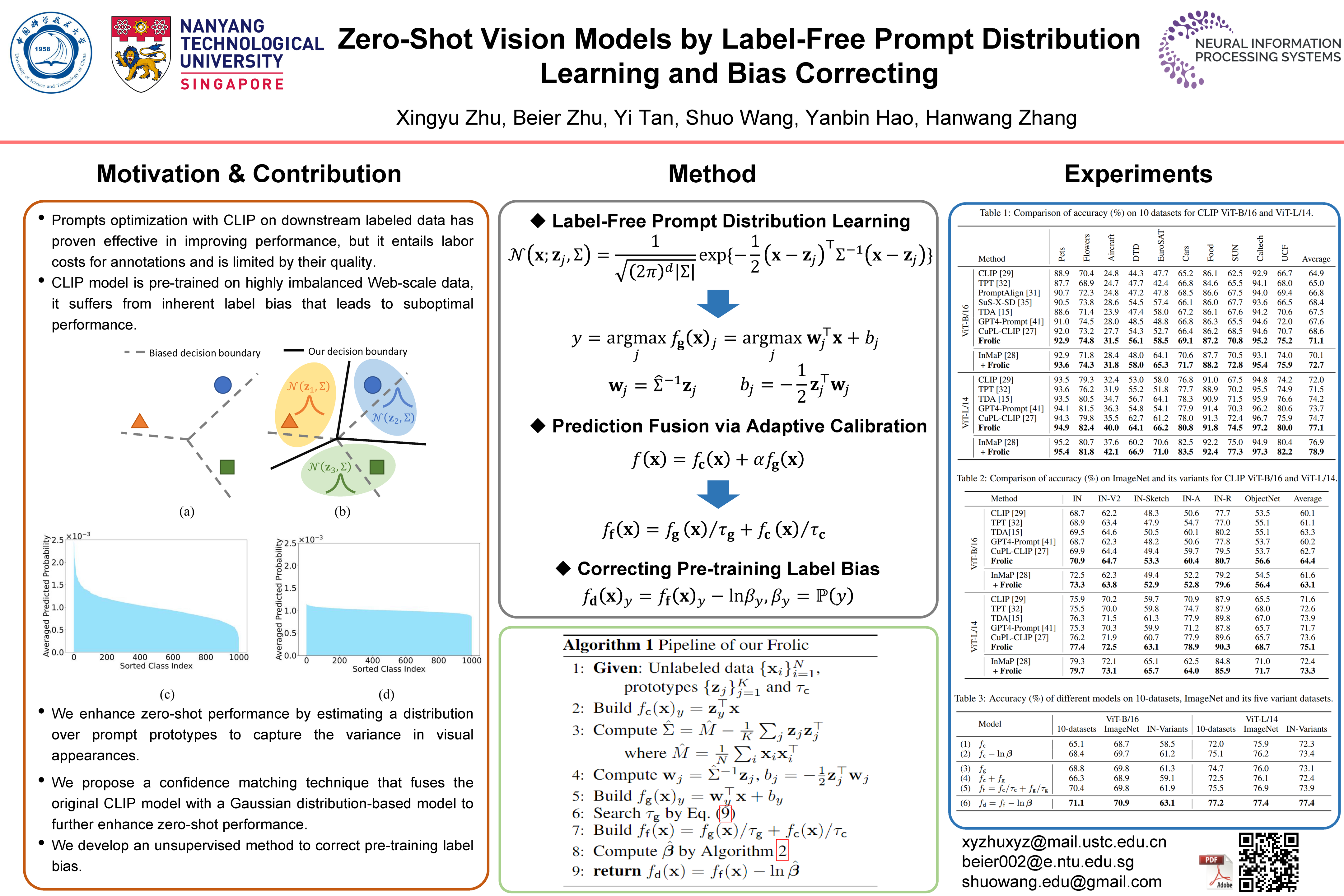
2023
- NeurIPSGeneralized logit adjustment: Calibrating fine-tuned models by removing label bias in foundation models Imbalanced & Fair LearningBeier Zhu, Kaihua Tang, Qianru Sun, and 1 more authorIn Advances in Neural Information Processing Systems
Foundation models like CLIP allow zero-shot transfer on various tasks without additional training data. Yet, the zero-shot performance is less competitive than a fully supervised one. Thus, to enhance the performance, fine-tuning and ensembling are also commonly adopted to better fit the downstream tasks. However, we argue that such prior work has overlooked the inherent biases in foundation models. Due to the highly imbalanced Web-scale training set, these foundation models are inevitably skewed toward frequent semantics, and thus the subsequent fine-tuning or ensembling is still biased. In this study, we systematically examine the biases in foundation models and demonstrate the efficacy of our proposed Generalized Logit Adjustment (GLA) method. Note that bias estimation in foundation models is challenging, as most pre-train data cannot be explicitly accessed like in traditional long-tailed classification tasks. To this end, GLA has an optimization-based bias estimation approach for debiasing foundation models. As our work resolves a fundamental flaw in the pre-training, the proposed GLA demonstrates significant improvements across a diverse range of tasks: it achieves 1.5 pp accuracy gains on ImageNet, an large average improvement (1.4-4.6 pp) on 11 few-shot datasets, 2.4 pp gains on long-tailed classification.
@inproceedings{zhu2023generalized, title = {Generalized logit adjustment: Calibrating fine-tuned models by removing label bias in foundation models}, author = {Zhu, Beier and Tang, Kaihua and Sun, Qianru and Zhang, Hanwang}, booktitle = {Advances in Neural Information Processing Systems}, year = {2023}, } - AAAIOralDebiased fine-tuning for vision-language models by prompt regularization Robust AdaptationBeier Zhu, Yulei Niu, Saeil Lee, and 2 more authorsIn AAAI Conference on Artificial Intelligence
We present a new paradigm for fine-tuning large-scale visionlanguage pre-trained models on downstream task, dubbed Prompt Regularization (ProReg). Different from traditional fine-tuning which easily overfits to the downstream task data, ProReg uses the prediction by prompting the pretrained model to regularize the fine-tuning. The motivation is: by prompting the large model "a photo of a [CLASS]", the fil-lin answer is only dependent on the pretraining encyclopedic knowledge while independent of the task data distribution, which is usually biased. Specifically, given a training sample prediction during fine-tuning, we first calculate its KullbackLeibler loss of the prompt prediction and Cross-Entropy loss of the ground-truth label, and then combine them with a proposed sample-wise adaptive trade-off weight, which automatically adjusts the transfer between the pretrained and downstream domains. On various out-of-distribution benchmarks, we show the consistently strong performance of ProReg compared with conventional fine-tuning, zero-shot prompt, prompt tuning, and other state-of-the-art methods.
@inproceedings{zhu2023debiased, title = {Debiased fine-tuning for vision-language models by prompt regularization}, author = {Zhu, Beier and Niu, Yulei and Lee, Saeil and Hur, Minhoe and Zhang, Hanwang}, booktitle = {AAAI Conference on Artificial Intelligence}, year = {2023}, } - AAAIOralLeveraging modality-specific representations for audio-visual speech recognition via reinforcement learning Speech RecognitionChen Chen, Yuchen Hu, Qiang Zhang, Heqing Zou, Beier Zhu, and 1 more authorIn AAAI conference on artificial intelligence
Audio-visual speech recognition (AVSR) has gained remarkable success for ameliorating the noise-robustness of speech recognition. Mainstream methods focus on fusing audio and visual inputs to obtain modality-invariant representations. However, such representations are prone to over-reliance on audio modality as it is much easier to recognize than video modality in clean conditions. As a result, the AVSR model underestimates the importance of visual stream in face of noise corruption. To this end, we leverage visual modality-specific representations to provide stable complementary information for the AVSR task. Specifically, we propose a reinforcement learning (RL) based framework called MSRL, where the agent dynamically harmonizes modality-invariant and modality-specific representations in the auto-regressive decoding process. We customize a reward function directly related to task-specific metrics (i.e., word error rate), which encourages the MSRL to effectively explore the optimal integration strategy. Experimental results on the LRS3 dataset show that the proposed method achieves state-of-the-art in both clean and various noisy conditions. Furthermore, we demonstrate the better generality of MSRL system than other baselines when test set contains unseen noises.
@inproceedings{chen2023leveraging, title = {Leveraging modality-specific representations for audio-visual speech recognition via reinforcement learning}, author = {Chen, Chen and Hu, Yuchen and Zhang, Qiang and Zou, Heqing and Zhu, Beier and Chng, Eng Siong}, booktitle = {AAAI conference on artificial intelligence}, year = {2023}, } - ICCVPrompt-aligned gradient for prompt tuning Robust AdaptationBeier Zhu, Yulei Niu, Yucheng Han, and 2 more authorsIn International Conference on Computer Vision
Thanks to the large pre-trained vision-language models (VLMs) like CLIP, we can craft a zero-shot classifier by "prompt", e.g., the confidence score of an image being "[CLASS]" can be obtained by using the VLM provided similarity measure between the image and the prompt sentence "a photo of a [CLASS]". Therefore, prompt shows a great potential for fast adaptation of VLMs to downstream tasks if we fine-tune the prompt-based similarity measure. However, we find a common failure that improper fine-tuning may not only undermine the prompt’s inherent prediction for the task-related classes, but also for other classes in the VLM vocabulary. Existing methods still address this problem by using traditional anti-overfitting techniques such as early stopping and data augmentation, which lack a principled solution specific to prompt. We present Prompt-aligned Gradient, dubbed ProGrad, to prevent prompt tuning from forgetting the the general knowledge learned from VLMs. In particular, ProGrad only updates the prompt whose gradient is aligned (or non-conflicting) to the "general direction", which is represented as the gradient of the KL loss of the pre-defined prompt prediction. Extensive experiments demonstrate the stronger few-shot generalization ability of ProGrad over state-of-the-art prompt tuning methods.
@inproceedings{zhu2023prompt,
  title = {Prompt-aligned gradient for prompt tuning},
  author = {Zhu, Beier and Niu, Yulei and Han, Yucheng and Wu, Yue and Zhang, Hanwang},
  booktitle = {International Conference on Computer Vision},
  year = {2023},
}
2022
- AAAIOralCross-domain empirical risk minimization for unbiased long-tailed classification Imbalanced & Fair LearningBeier Zhu, Yulei Niu, Xian-Sheng Hua, and 1 more authorIn Proceedings of the AAAI conference on artificial intelligence
We address the overlooked unbiasedness in existing long-tailed classification methods: we find that their overall improvement is mostly attributed to the biased preference of tail over head, as the test distribution is assumed to be balanced; however, when the test is as imbalanced as the long-tailed training data – let the test respect Zipf’s law of nature – the tail bias is no longer beneficial overall because it hurts the head majorities. In this paper, we propose Cross-Domain Empirical Risk Minimization (xERM) for training an unbiased model to achieve strong performances on both test distributions, which empirically demonstrates that xERM fundamentally improves the classification by learning better feature representation rather than the head vs. tail game. Based on causality, we further theoretically explain why xERM achieves unbiasedness: the bias caused by the domain selection is removed by adjusting the empirical risks on the imbalanced domain and the balanced but unseen domain.
@inproceedings{zhu2022cross,
  title = {Cross-domain empirical risk minimization for unbiased long-tailed classification},
  author = {Zhu, Beier and Niu, Yulei and Hua, Xian-Sheng and Zhang, Hanwang},
  booktitle = {Proceedings of the AAAI conference on artificial intelligence},
  year = {2022},
}
2021
- TIPStructure-coherent deep feature learning for robust face alignment Face AlignmentChunze Lin, Beier Zhu, Quan Wang, and 4 more authorsIEEE Transactions on Image Processing
In this paper, we propose a structure-coherent deep feature learning method for face alignment. Unlike most existing face alignment methods which overlook the facial structure cues, we explicitly exploit the relation among facial landmarks to make the detector robust to hard cases such as occlusion and large pose. Specifically, we leverage a landmark-graph relational network to enforce the structural relationships among landmarks. We consider the facial landmarks as structural graph nodes and carefully design the neighborhood to passing features among the most related nodes. Our method dynamically adapts the weights of node neighborhood to eliminate distracted information from noisy nodes, such as occluded landmark point. Moreover, different from most previous works which only tend to penalize the landmarks absolute position during the training, we propose a relative location loss to enhance the information of relative location of landmarks. This relative location supervision further regularizes the facial structure. Our approach considers the interactions among facial landmarks and can be easily implemented on top of any convolutional backbone to boost the performance. Extensive experiments on three popular benchmarks, including WFLW, COFW and 300W, demonstrate the effectiveness of the proposed method. In particular, due to explicit structure modeling, our approach is especially robust to challenging cases resulting in impressive low failure rate on COFW and WFLW datasets.
@article{lin2021structure,
  title = {Structure-coherent deep feature learning for robust face alignment},
  author = {Lin, Chunze and Zhu, Beier and Wang, Quan and Liao, Renjie and Qian, Chen and Lu, Jiwen and Zhou, Jie},
  journal = {IEEE Transactions on Image Processing},
  volume = {30},
  pages = {5313--5326},
  year = {2021},
}
2019
- TSGFault location for radial distribution network via topology and reclosure-generating traveling waves Power SystemShenxing Shi, Beier Zhu, Aoyu Lei, and 1 more authorIEEE Transactions on Smart Grid
Fault location in distribution networks is difficult for multiple discontinuities, such as branches and junction points. This paper proposes a fault location scheme using network topology information and reclosure-generating traveling waves. Based on the topology, the circuit breaker closure-generating normal traveling waves (CNTWs) can be analyzed. When permanent faults occur, the circuit breaker reclosure-generating fault traveling waves (RFTWs) contain the information on fault position. The difference between the CNTWs and RFTWs, defined as reclosing superimposed traveling waves (RSTWs), is calculated. For RSTWs, their initial traveling waves are detected by wavelet transform. The time difference between the reclosing instant and the arrival instant of the reflected traveling wave of the fault point is employed to calculate the fault distance. Moreover, due to large numbers of branches, a fault distance may correspond to many sections. To determine the fault section, a database which contains the RSTWs induced by the faults occur in each section is built. The fault section can be identified by finding the most similar signals in the database by taking advantage of an improved dynamic time warping method. The simulation results indicate that the scheme can locate fault for distributed feeders regardless of grounding system type, load variation, and fault type.
@article{shi2019fault,
  title = {Fault location for radial distribution network via topology and reclosure-generating traveling waves},
  author = {Shi, Shenxing and Zhu, Beier and Lei, Aoyu and Dong, Xinzhou},
  journal = {IEEE Transactions on Smart Grid},
  volume = {10},
  number = {6},
  pages = {6404--6413},
  year = {2019},
  publisher = {IEEE},
}
2018
- TSGFault classification for transmission lines based on group sparse representation Power SystemShenxing Shi, Beier Zhu, Sohrab Mirsaeidi, and 1 more authorIEEE Transactions on Smart Grid
Fault classification is an important aspect of the protective relaying system for transmission lines. This paper proposes a new method based on group sparse representation for fault classification in transmission lines in which half-cycle superimposed current signals are measured for the classification task. When compared to conventional feature extraction methods, the proposed method in this paper alleviates the requirement to manually design feature. Signals are factorized over an overcomplete basis in which elements are the fault signals themselves. The algorithm of classification is based on the idea that the training samples of a particular fault type approximately form a linear basis for any test sample belonging to that class. Solved by l2,1-minimization, the coefficient should be group sparse, and its non-zero entries correspond to particular group of correlated training samples. It is illustrated that the proposed classification method can be properly modified to deal with noise-containing signals. Moreover, dimension reduction is performed using random mapping technique. The results of several simulations are carried out by PSCAD/EMTDC and field data in real system indicate that the proposed method is accurate and fast for fault classification, and has a high robustness to noise.
@article{shi2018fault,
  title = {Fault classification for transmission lines based on group sparse representation},
  author = {Shi, Shenxing and Zhu, Beier and Mirsaeidi, Sohrab and Dong, Xinzhou},
  journal = {IEEE Transactions on Smart Grid},
  volume = {10},
  number = {4},
  pages = {4673--4682},
  year = {2018},
  publisher = {IEEE},
}