Least Squares: Closed Form, QR, SVD, Gradient Descent, and Ridge Regression
1. Least Squares Problem
Suppose we want to solve a linear system \(A\mathbf{x}=\mathbf{b}\) with \(A \in \mathbb{R}^{m \times n}\), \(\mathbf{b} \in \mathbb{R}^m\) and \(m \geq n\). Since the system is typically overdetermined, it may not admit an exact solution. Instead, we seek a vector \(\hat{\mathbf{x}}\) such that \(A\hat{\mathbf{x}} \approx \mathbf{b}\). This leads to the least squares (LS) problem:
\begin{equation}\label{eq:ls} \hat{\mathbf{x}}=\arg\min_{\mathbf{x}\in\mathbb{R}^n}\lVert A\mathbf{x}-\mathbf{b}\rVert_2^2. \end{equation}
Least squares arises ubiquitously in regression problems. In this blog, we review and compare five common approaches for solving LS problems, including the closed-form solution, QR factorization, SVD, gradient descent, and ridge regression. Our focus is on their numerical stability and behavior under rank deficiency.
2. Normal Equations and the Closed-Form Solution
Solving \eqref{eq:ls} leads to the normal equations:
\begin{equation}\label{eq:normal-equations} {A}^\top {A}\, \hat{\mathbf{x}} = {A}^\top \mathbf{b}. \end{equation}
When \({A}\) has full column rank \(n\), \({A}^\top {A}\) is symmetric positive definite and invertible, and the solution can be written in closed form as
\[\boxed{\hat{\mathbf{x}} = ({A}^\top {A})^{-1} {A}^\top \mathbf{b}}.\]The matrix \({A}^+ := ({A}^\top {A})^{-1} {A}^\top\) is the Moore–Penrose pseudoinverse of \({A}\).
Proof of \eqref{eq:normal-equations} (Click to expand)
Expanding the objective:
\[\|{A}\mathbf{x} - \mathbf{b}\|_2^2 = \mathbf{x}^\top {A}^\top {A}\, \mathbf{x} - 2\mathbf{b}^\top {A}\mathbf{x} + \mathbf{b}^\top \mathbf{b}.\]Taking the gradient w.r.t \(\mathbf{x}\) and setting it to zero:
\[\nabla_{\mathbf{x}}\|{A}\mathbf{x} - \mathbf{b}\|_2^2 = 2{A}^\top {A}\, \mathbf{x} - 2{A}^\top \mathbf{b} = \mathbf{0},\]which gives the normal equations:
\[{A}^\top {A}\, \hat{\mathbf{x}} = {A}^\top \mathbf{b}.\]Limitation. This formula is valuable analytically, but computing the solution through the normal equations is often numerically undesirable. Even when \(A\) has full column rank, the matrix may still be ill-conditioned, and forming \(A^\top A\) further amplifies this issue. To make this precise, we briefly recall the notion of the condition number.
2.1 Condition Number
The main numerical issue of the normal equations is related to the condition number. For an invertible matrix \(A\), the spectral condition number w.r.t \(\ell_2\) norm is defined as
\[\kappa_2(A):= \|A\|_2 \|A^{-1}\|_2\]For a symmetric positive definite matrix \(A\), this becomes
\begin{equation}\label{eq:kappa} \kappa_2(A)=\frac{\lambda_\mathsf{max}(A)}{\lambda_\mathsf{min}(A)}, \end{equation}
where \(\lambda_\mathsf{max}(A)\) and \(\lambda_\mathsf{min}(A)\) denote the largest and smallest eigen values of \(A\).
Definition of Matrix Norm (Click to expand))
Given any norm \(\|\cdot\|\) on the space \(\mathbb{R}^n\) of \(n\)-dimensional vectors with real entries, the suborinate matrix norm on the \(\mathbb{R}^{n\times n}\) matrices with real entries is defined by
\[\|A\|=\mathrm{max}_{\mathbf{v}\in \mathbb{R}^n\backslash \{\mathbf{0}\}}\frac{\|A\mathbf{v}\|}{\|\mathbf{v}\|}\]Proof of \eqref{eq:kappa} (Click to expand)
Since \(A\) is symmetric positive definite, all its eigenvalues are real and positive, and there exists an orthonormal basis of eigenvectors \(\mathbf{w}_1,\dots,\mathbf{w}_n\) such that
\[A\mathbf{w}_i=\lambda_i \mathbf{w}_i,\quad i=1,2,\dots,n.\]Without loss of generality, assume that \(0<\lambda_1\le \lambda_2\le \cdots \le \lambda_n.\) Now let \(\mathbf{u} \in \mathbb{R}^n\) be arbitrary and write it as
\[\mathbf{u}=c_1\mathbf{w}_1+\cdots+c_n\mathbf{w}_n.\]Then
\[A\mathbf{u}=c_1\lambda_1 \mathbf{w}_1+\cdots+c_n\lambda_n \mathbf{w}_n.\]Using the orthonormality of \(\mathbf{w}_1,\dots,\mathbf{w}_n\), we have
\[\|Au\|_2^2 = (c_1\lambda_1 w_1+\cdots+c_n\lambda_n w_n)^\top (c_1\lambda_1 w_1+\cdots+c_n\lambda_n w_n) = c_1^2\lambda_1^2+\cdots+c_n^2\lambda_n^2.\]Since \(\lambda_i\le \lambda_n\) for all \(i\), it follows that \(\|A\mathbf{u}\|_2^2 \le (c_1^2+\cdots+c_n^2)\lambda_n^2.\) Again by orthonormality, \(\|\mathbf{u}\|_2^2=c_1^2+\cdots+c_n^2.\) Hence \(\|A\mathbf{u}\|_2^2 \le \lambda_n^2 \|\mathbf{u}\|_2^2,\) and therefore \(\|A\mathbf{u}\|_2 \le \lambda_n \|\mathbf{u}\|_2.\) By the definition of the matrix \(\ell_2\)-norm, this implies
\[\|A\|_2 = \lambda_n = \lambda_\mathsf{max}(A).\]Similarly, we have
\[\|A^{-1}\|_2 = \frac{1}{\lambda_1} = \frac{1}{\lambda_\mathsf{min}(A)}.\]By the definition of the condition number,
\[\kappa_2(A)=\frac{\lambda_\mathsf{max}(A)}{\lambda_\mathsf{min}(A)}.\]The condition number measures the sensitivity of the solution of a linear system to pertubations in the data. Consider
\[M \mathbf{x} = \mathbf{c}\]If \(\mathbf{c}\) is perturbed to \(\mathbf{c}+\delta \mathbf{c}\) (for example, rounding errors during the calculation.), then the solution changes to \(\mathbf{x}+\delta \mathbf{x}\), where
\[M \delta \mathbf{x} = \delta \mathbf{c}.\]This leads to the relative error bound
\[\frac{\|\delta \mathbf{x}\|_2}{\|\mathbf{x}\|_2^2} \leq \kappa_2(M) \frac{\|\delta \mathbf{c}\|_2}{\|\mathbf{c}\|_2^2}\]Proof (Click to expand)
Evidently, \(\mathbf{c}=M\mathbf{x}\) and \(\delta \mathbf{x} = M^{-1}\delta \mathbf{c}\). Further
\(\|\mathbf{c}\|\leq \|M\|\|\mathbf{x}\|\) and \(\|\delta \mathbf{x}\|\leq \|M^{-1}\|\|\delta \mathbf{c}\|\).
The result follows immediately by multiplying these inequalities.
Importantly, this is an upper bound: a large condition number does not mean that every perturbation causes a large error, but it does mean that the system is potentially unstable in the worst case. For the normal equations, we solve
\[{A}^\top {A}\, \hat{\mathbf{x}} = {A}^\top \mathbf{b}.\]Since
\[\kappa_2(A^\top A) = \kappa_2(A)^2,\]forming \(A^\top A\) squares the condition number and may significantly worsen numerical stability. This is why, despite its simple closed form, the normal-equation approach is often avoided in practice.
For example, if \(A= \begin{pmatrix} \varepsilon & 0\\ 0 & 1 \end{pmatrix}\) where \(\varepsilon\in(0,1)\), then \(\kappa_2(A)=\varepsilon^{-1}>1\), while \(\kappa_2(A^\top A)=\varepsilon^{-2} =\varepsilon^{-1}\kappa_2(A)\gg \kappa_2(A)\) when \(0<\varepsilon\ll 1\).
3. QR Decomposition
There are various alternative techniques which avoid the direct construction of the normal matrix \(A^\top A\), and so do not lead to this extreme ill-conditioning. Here, we shall describe one algorithm based on QR decomposition, which begins by factorizing the matrix \(A\) into an orthogonal matrix \(Q\) and an upper triangular matrix \(R\) (see figure below).
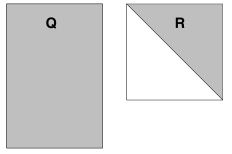
The following theorem shows that such a decomposition exists.
Suppose that \(A \in \mathbb{R}^{m \times n}\) where \(m \geq n\). Then, \(A\) can be written in the form
\[A = {Q}{R},\]where \({R}\) is an upper triangular \(n \times n\) matrix, and \(Q\) is an \(m \times n\) matrix which satisfies
\[{Q}^\top {Q} = I_n,\]where \(I_n\) is the \(n \times n\) identity matrix. If \(\mathrm{rank}(A) = n\), then \(R\) is nonsingular.
Proof of Theorem 2.1 (Click to expand)
We use induction on \(n\), the number of columns in \(A\). The theorem clearly holds when \(n=1\) so that \(A\) has only one column. Indeed, writing \(\mathbf{c}\) for this column vector and assuming that \(\mathbf{c}\neq \mathbf{0}\), the matrix \({Q}\) has just one column, the vector \(\mathbf{c}/\|\mathbf{c}\|_2\), and \({R}\) has a single element, \(\|\mathbf{c}\|_2\).
Suppose that the theorem is true when \(n=k\), where \(1\le k < m\). Consider a matrix \(A\) which has \(m\) rows and \(k+1\) columns, partitioned as
\[A=(A_k\ \ \mathbf{a}),\]where \(\mathbf{a} \in\mathbb{R}^m\) is a column vector and \(A_k\) has \(k\) columns. To obtain the desired factorisation \({Q}{R}\) of \(A\) we seek \({Q}=({Q}_k\ \ \mathbf{q})\) and
\[{R}= \begin{pmatrix} {R}_k & \mathbf{r} \\ 0 & {\alpha} \end{pmatrix}\]such that
\[A=(A_k\ \ \mathbf{a}) = ({Q}_k\ \ \mathbf{q}) \begin{pmatrix} {R}_k & \mathbf{r} \\ 0 & {\alpha} \end{pmatrix}.\]Multiplying this out and requiring that \({Q}^{\top}{Q}=I_{k+1}\), the identity matrix of order \(k+1\), we conclude that
\[\begin{aligned} A_k &= {Q}_k{R}_k, \\ \mathbf{a} &= {Q}_k \mathbf{r} + \mathbf{q} {\alpha}, \\ {Q}_k^{\top}{Q}_k &= I_k, \\ \mathbf{q}^{\top}{Q}_k &= \mathbf{0}^{\top}, \\ \mathbf{q}^{\top}\mathbf{q} &= \mathbf{1}. \end{aligned}\]These equations show that \({Q}_k{R}_k\) is the factorisation of \(A_k\), which exists by the inductive hypothesis, and then lead to
\[\begin{aligned} \mathbf{r} &= {Q}_k^{\top}\mathbf{a}, \\ \mathbf{q} &= (1/{\alpha})\bigl(\mathbf{a}-{Q}_k{Q}_k^{\top}\mathbf{a}\bigr), \end{aligned}\]where \({\alpha}=\|\mathbf{a}-{Q}_k{Q}_k^{\top}\mathbf{a}\|_2\)). The number \({\alpha}\) is the constant required to ensure that the vector \(\mathbf{q}\) is normalised.
With these definitions of \(\mathbf{q}\), \(\mathbf{r}\), \(\alpha\), \({Q}_k\) and \({R}_k\) we have constructed the required factors of \(A\), showing that the theorem is true when \(n=k+1\). Since it holds when \(n=1\) the induction is complete.
With QR factorisation, solving \eqref{eq:ls} is equivalent to solve:
\[\boxed{R\mathbf{x}=Q^\top \mathbf{b}}\]Proof (Click to expand)
Replace \(A\) with \(QR\), we have
\[\min_\mathbf{x}\|A\mathbf{x}-\mathbf{b}\|_2^2=\min_\mathbf{x}\|QR\mathbf{x}-\mathbf{b}\|_2^2.\]Decompose $\mathbf{b}$ as
\[\mathbf{b}=QQ^\top\mathbf{b} + (I-QQ^\top)\mathbf{b}.\]This leads to
\[\|QR\mathbf{x}-\mathbf{b}\|_2^2=\|Q(R\mathbf{x}-Q^\top\mathbf{b}) - (I-QQ^\top)\mathbf{b}\|_2^2.\]Let
\[\mathbf{u}:=Q(R\mathbf{x}-Q^\top\mathbf{b}), \quad \mathbf{v}=(I-QQ^\top)\mathbf{b}.\]It is evident that \(\mathbf{u} \perp \mathbf{v}\), as
\[\mathbf{u}^\top \mathbf{v} = (R\mathbf{x}-Q^\top\mathbf{b})^\top Q^\top (I-QQ^\top)\mathbf{b}=(R\mathbf{x}-Q^\top\mathbf{b})^\top (Q^\top- Q^\top)\mathbf{b} = \mathbf{0}\]Recall that \(\|\mathbf{u}-\mathbf{v}\|_2^2=\|\mathbf{u}\|_2^2+\|\mathbf{v}\|_2^2\) if \(\mathbf{u} \perp \mathbf{v}\). Therefore
\[\|QR\mathbf{x}-\mathbf{b}\|_2^2=\|R\mathbf{x}-Q^\top\mathbf{b}\|_2^2 + \| (I-QQ^\top)\mathbf{b}\|_2^2.\]Note that the second term on RHS is not related to \(\mathbf{x}\). Hence, \(\mathbf{x}\) defined as the solution of \(R\mathbf{x}=Q^\top\mathbf{b}\), is the required least squares solution.
Since left multiplication by an orthogonal matrix does not change singular values, \(R\) has the same singular values as \(A\). Hence,
\[\kappa_2(R)=\kappa_2(A)\]Therefore, QR factorization avoids the squaring of the condition number (recall that condition number for the normal equations is \(\kappa_2(A)^2\)) and is numerically more stable than the normal-equation approach.
4. Singular Value Decomposition (SVD)
When using QR factorization to solve a least-squares problem, we typically assume that \(A\) has full column rank. In practice, however, \(A\) may be rank-deficient. In that case, more appropriate choices include SVD or gradient descent with appropriate initialization. We begin with the SVD of \(A\):
\[A=U\Sigma V^\top,\]where \(U\in\mathbb{R}^{m\times m}\) and \(V\in\mathbb{R}^{n\times n}\) are orthogonal matrices, and \(\Sigma\in\mathbb{R}^{m\times n}\) is diagonal except possibly for trailing zero rows or columns. Suppose that \(\operatorname{rank}(A)=r\). Then we may write the SVD in block form as
\[A= [U_1\ U_2] \begin{bmatrix} \Sigma_1 & 0\\ 0 & 0 \end{bmatrix} \begin{bmatrix} V_1^\top\\ V_2^\top \end{bmatrix},\]where:
- \(U_1\in\mathbb{R}^{m\times r}\) and \(V_1\in\mathbb{R}^{n\times r}\),
- \(U_2\in\mathbb{R}^{m\times (m-r)}\) and \(V_2\in\mathbb{R}^{n\times (n-r)}\),
- \(\Sigma_1\in\mathbb{R}^{r\times r}\) is diagonal with positive singular values.
This decomposition reveals the geometry of the least-squares problem:
- the columns of \(V_2\) span the null space \(\mathrm{Null}(A)\),
- the columns of \(V_1\) correspond to the effective directions of \(A\),
- the columns of \(U_1\) span the column space \(\mathrm{Col}(A)\).
Using the SVD of \(A\), we obtain \(\|A\mathbf{x}-\mathbf{b}\|_2^2 = \|U\Sigma V^\top \mathbf{x}-\mathbf{b}\|_2^2.\) Since \(U\) is orthogonal and preserves the Euclidean norm,
\[\|A\mathbf{x}-\mathbf{b}\|_2^2 = \|\Sigma V^\top \mathbf{x}-U^\top \mathbf{b}\|_2^2.\]Now write
\[V^\top \mathbf{x} = \begin{bmatrix} V_1^\top\\ V_2^\top \end{bmatrix}\mathbf{x} = \begin{bmatrix} \mathbf{y}\\ \mathbf{z} \end{bmatrix}, \qquad U^\top \mathbf{b} = \begin{bmatrix} U_1^\top\\ U_2^\top \end{bmatrix}\mathbf{b} = \begin{bmatrix} \mathbf{c}\\ \mathbf{d} \end{bmatrix},\]where \(\mathbf{y},\mathbf{c}\in\mathbb{R}^r\) and \(\mathbf{z}\in\mathbb{R}^{n-r}\), \(\mathbf{d}\in\mathbb{R}^{m-r}\). Hence,
\[\|A\mathbf{x}-\mathbf{b}\|_2^2 = \left\| \begin{bmatrix} \Sigma_1\mathbf{y}\\ 0 \end{bmatrix} - \begin{bmatrix} \mathbf{c}\\ \mathbf{d} \end{bmatrix} \right\|_2^2 = \|\Sigma_1\mathbf{y}-\mathbf{c}\|_2^2+\|\mathbf{d}\|_2^2.\]The second term is independent of \(\mathbf{x}\), and the first term depends only on \(\mathbf{y}\), not on \(\mathbf{z}\). Since \(\Sigma_1\) is invertible, the minimizing choice of \(\mathbf{y}\) is \(\mathbf{y}=\Sigma_1^{-1}\mathbf{c}=\Sigma_1^{-1}U_1^\top \mathbf{b}.\) Thus every least-squares solution can be written as
\[\mathbf{x} = V_1\Sigma_1^{-1}U_1^\top \mathbf{b}+V_2\mathbf{z}, \qquad \mathbf{z}\in\mathbb{R}^{n-r}.\]Equivalently, if we define \(\mathbf{x}^\dagger:=V_1\Sigma_1^{-1}U_1^\top \mathbf{b},\) then all least-squares solutions are of the form
\[\mathbf{x}=\mathbf{x}^\dagger+\mathbf{z}, \qquad \mathbf{z}\in\mathrm{Null}(A).\]The minimum-norm least-squares solution is
\[\boxed{ \mathbf{x}^\dagger = V_1\Sigma_1^{-1}U_1^\top \mathbf{b}. }\]Therefore, SVD is often the preferred tool when \(A\) is singular or nearly singular.
5. Gradient Descent and Implicit Bias
In the rank-deficient setting, SVD provides a natural and explicit way to characterize all least-squares solutions and to identify the minimum-norm one. Interestingly, gradient descent offers another effective approach: although it does not explicitly impose a minimum-norm criterion, with zero initialization it implicitly converges to the same solution.
Consider the least-squares objective
\[f(\mathbf{x})=\frac{1}{2}\|A\mathbf{x}-\mathbf{b}\|_2^2.\]Gradient descent updates take the form
\[\mathbf{x}_{t+1} = \mathbf{x}_t-\eta \nabla f(\mathbf{x}_t) = \mathbf{x}_t-\eta A^\top(A\mathbf{x}_t-\mathbf{b}),\]where \(\eta>0\) is the step size.
When the least-squares solution is not unique, gradient descent exhibits an important implicit bias: if initialized at \(\mathbf{x}_0=0,\) then, under a suitable choice of step size, it converges to the same minimum-norm least-squares solution derived in the previous section, namely
\[\mathbf{x}^\dagger=A^+\mathbf{b}.\]The key reason is that every gradient update lies in the range of \(A^\top\). Indeed,
\[\mathbf{x}_{t+1}-\mathbf{x}_t = -\eta A^\top(A\mathbf{x}_t-\mathbf{b}) \in \mathrm{range}(A^\top).\]Since \(\mathbf{x}_0=0\in \mathrm{range}(A^\top)\), it follows by induction that \(\mathbf{x}_t\in \mathrm{range}(A^\top) \qquad \text{for all } t\ge 0.\)
On the other hand, from the SVD analysis in the previous section, all least-squares solutions can be written as
\[\mathbf{x} = \mathbf{x}^\dagger+\mathbf{z}, \qquad \mathbf{z}\in \mathrm{Null}(A),\]where \(\mathbf{x}^\dagger=A^+\mathbf{b}\) is the minimum-norm least-squares solution.
Now recall the fundamental orthogonal decomposition \(\mathbb{R}^n = \mathrm{range}(A^\top)\oplus \mathrm{Null}(A).\) Therefore, among all least-squares solutions, the unique one that lies entirely in \(\mathrm{range}(A^\top)\) is precisely \(\mathbf{x}^\dagger\). Since gradient descent initialized at zero never leaves \(\mathrm{range}(A^\top)\), if it converges to a least-squares solution, that limit must be \(\mathbf{x}^\dagger=A^+\mathbf{b}.\)
This shows that zero initialization induces an implicit regularization effect: although the objective itself does not explicitly prefer one least-squares solution over another, gradient descent selects the minimum-norm one through its optimization trajectory.
5.1 Why Initialization Matters
The conclusion above depends crucially on the initialization. If gradient descent starts from a nonzero initial point \(\mathbf{x}_0\), then its component in \(\mathrm{Null}(A)\) is preserved throughout the iterations. Indeed, if
\[\mathbf{x}_0=\mathbf{x}_0^{\parallel}+\mathbf{x}_0^{\perp}, \qquad \mathbf{x}_0^{\parallel}\in \mathrm{range}(A^\top), \quad \mathbf{x}_0^{\perp}\in \mathrm{Null}(A),\]then
\[A\mathbf{x}_0^{\perp}=0, \qquad A^\top A\mathbf{x}_0^{\perp}=0.\]Hence the null-space component is never changed by gradient descent. As a result, the limit point is generally not the minimum-norm solution, but rather the minimum-norm solution plus the initial null-space component.
6. Ridge Regression
Besides SVD and gradient descent, another common approach for handling ill-conditioned or rank-deficient least-squares problems is ridge regression. The basic idea is to replace the original least-squares problem with the regularized problem
\[\hat{\mathbf{x}}_\lambda = \arg\min_{\mathbf{x}} \left( \|A\mathbf{x}-\mathbf{b}\|_2^2 + \lambda \|\mathbf{x}\|_2^2 \right),\]where \(\lambda>0\) is the regularization parameter. The additional term \(\lambda\|\mathbf{x}\|_2^2\) discourages solutions with large norm. The solution can be written in closed form as
\[\boxed{ \hat{\mathbf{x}}_\lambda = (A^\top A+\lambda I)^{-1}A^\top \mathbf{b}. }\]Proof (Click to expand)
Taking the gradient of the ridge objective and setting it to zero, we obtain
\[2A^\top(A\mathbf{x}-\mathbf{b})+2\lambda \mathbf{x}=0,\]which gives
\[(A^\top A+\lambda I)\mathbf{x}=A^\top \mathbf{b}.\]Since \(\lambda>0\), the matrix \(A^\top A+\lambda I\) is symmetric positive definite and hence invertible. Therefore, the ridge solution admits the closed-form expression
\[\boxed{ \hat{\mathbf{x}}_\lambda = (A^\top A+\lambda I)^{-1}A^\top \mathbf{b}. }\]This formula shows why ridge regression is useful in the rank-deficient setting: even if \(A^\top A\) is singular, adding \(\lambda I\) shifts the eigenvalues away from zero and makes the system invertible.
6.1 Connection to the Minimum-Norm Solution
It is also useful to compare ridge regression with the minimum-norm solution from a constrained-optimization perspective. Recall that the minimum-norm solution can be defined as
\[\min_{\mathbf{x}\in\mathbb{R}^n}\|\mathbf{x}\|_2^2 \qquad \text{subject to} \qquad A\mathbf{x}=\mathbf{b}.\]Using a Lagrange multiplier \(\boldsymbol{\lambda}\), we define
\[\mathcal{L}(\mathbf{x},\boldsymbol{\lambda}) = \|\mathbf{x}\|_2^2+\boldsymbol{\lambda}^\top(A\mathbf{x}-\mathbf{b}).\]Thus, the minimum-norm solution is obtained by minimizing the norm under a hard equality constraint. By contrast, ridge regression does not enforce the constraint \(A\mathbf{x}=\mathbf{b}\) exactly. Instead, it solves
\[\mathcal{L}_\lambda(\mathbf{x}) = \|A\mathbf{x}-\mathbf{b}\|_2^2+\lambda\|\mathbf{x}\|_2^2 ,\]which replaces the hard constraint by a soft penalty. In this sense, ridge regression introduces an explicit trade-off between data fitting and solution norm, whereas the minimum-norm formulation minimizes the norm among exact solutions.
Rank deficiency alone is not the main reason to use ridge regression, since the minimum-norm solution already gives a natural canonical solution in that case. The real advantage of ridge appears in noisy or nearly singular settings. In exact or nearly noiseless settings, the minimum-norm solution is often the most faithful canonical solution to the original least-squares problem. In contrast, when \(A\) or \(\mathbf{b}\) is noisy, ridge regression is usually more robust, since it explicitly suppresses unstable small-singular-value directions by introducing a norm penalty. Thus, the minimum-norm solution is more natural from an analytical viewpoint, whereas ridge regression is often preferable from a practical viewpoint.
7. Summary
| Method | Key property |
|---|---|
| Normal equations | Closed form, but may be numerically unstable |
| QR decomposition | Stable solver for the original LS problem |
| SVD | Explicitly selects the minimum-norm solution |
| Gradient descent | Implicitly selects the minimum-norm solution |
| Ridge regression | Explicit regularization for robustness; but not faithful to original objective |
8. Reference
- Endre Suli and David F. Mayers. An introduction to numerical analysis. Cambridge University press 2003.
- Tengyu Ma. Lecture notes for machine learning theory.